
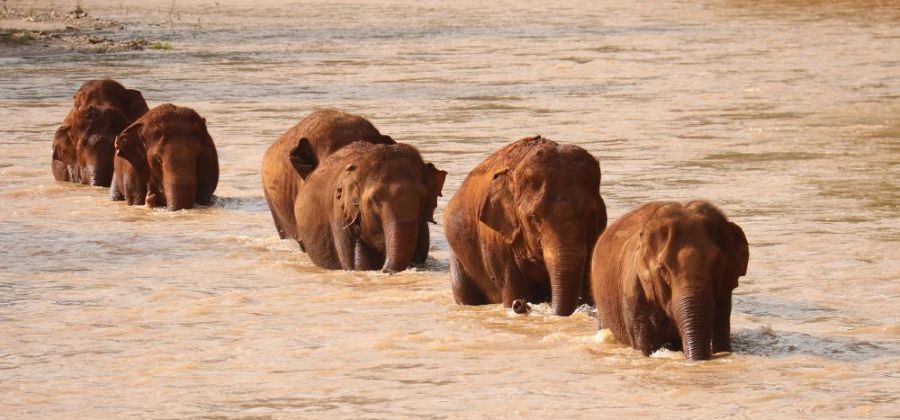
As I’m writing these lines, it’s early evening and I’m comfortably settled in my room. But this is no ordinary room – just a few hundred meters away, an elephant trumpets into the night, and a huge smile spreads across my face. I can’t believe I’m really here: as a volunteer with elephants in Thailand, at Elephant Nature Park. This magical place is about so much more than “just” being around elephants. It’s a sanctuary in every sense of the word, a place that makes you feel deeply, teaches you about resistance and the power of love, about freedom and compassion. A place that breaks your heart, but heals it at the same time.
Introduction to Elephant Nature Park
But let’s start at the beginning. Elephant Nature Park (ENP) is a sanctuary for rescued elephants in Northern Thailand, not far from Chiang Mai. It allows visitors to see elephants up close, all while following a strict “hands off” policy. And it offers volunteer programs, where you can live on the sanctuary for a week, help with daily tasks and gain a deeper insight into the elephants’ lives. That’s exactly what we did, and in this article, I’m going to share our personal experience of volunteering with elephants in Thailand at ENP.
If you’re reading this article, chances are that you’ve already heard about Elephant Nature Park and want more details about visiting or volunteering. We’ll share all the practical information that we think can be useful. And in case you stumbled upon this article simply by chance, we hope our experience inspires you to dive into the incredible world of elephants – and maybe even plan your own journey as a volunteer with elephants in Thailand one day!

Elephants in Thailand
Thailand is often called the “Land of Elephants” – and for good reason. For centuries, elephants have been deeply connected to Thai culture, religion and history. They are symbols of strength, wisdom and loyalty. Sadly, most elephants in today’s world experience a life far removed from their true nature.
Today, only a fraction of elephants in Thailand live wild and free. The majority are in captivity, used in industries such as logging (officially banned in 1989), tourism, and even street begging. Many have been forced to perform in shows, give rides, or carry tourists for hours every day. What might look “fun” or “harmless” to visitors is actually the result of years of training through painful methods, where the elephant’s spirit is broken to make them obey.

This is why sanctuaries like Elephant Nature Park are so important. They offer a safe place for elephants to recover, both physically and emotionally, from the traumas they’ve endured. A place where they no longer have to perform or work, but can simply be elephants again: roaming, eating, socializing and healing at their own pace.
Story of Elephant Nature Park
Elephant Nature Park (ENP) was founded in the 1990s by Lek Chailert, a woman whose life mission has been to fight for the well-being of elephants in Thailand and beyond. Her journey started with rescuing a single elephant, but over the years the sanctuary has grown into a haven for more than 100 animals.

What makes ENP so unique is not just the number of elephants it shelters, but its philosophy. The park operates on a strict “no riding, no touching” policy, ensuring that the animals can live as naturally as possible. Instead of being forced to interact with visitors, the elephants choose when (and if) they want to approach.
But ENP is much more than an elephant sanctuary. The grounds are also home to hundreds of rescued dogs (some in wheelchairs) and cats, as well as buffalo, cows, and even horses; all saved from abuse, abandonment or slaughter. The coexistence of all these species is a true symbol of respect for all life.

What started as one woman’s vision has now become a global example of ethical animal tourism and conservation. Elephant Nature Park not only rescues animals, but also raises awareness, educates visitors and inspires people around the world to question the way humans treat animals.
Volunteering at Elephant Nature Park in Thailand
The Elephant Nature Park volunteer program runs weekly from Monday to Sunday. If you’re based in Chiang Mai, transport can be organized – they pick you up directly from your accommodation and bring you to Elephant Nature Park.
Volunteer Rooms at Elephant Nature Park
Depending on the number of volunteers, the rooms can be either shared or private. During our stay, the group was quite small, with only 12 volunteers, so everyone traveling alone got their own room. All rooms come with a bathroom and a fan, and ours had more than enough space! We even had a second bed (besides the double), which served perfectly as storage space.
Vegan Food at the Sanctuary
Probably our favorite part after the elephants 😉 The entire sanctuary is fully vegan, which was actually a big reason we chose this volunteer program over other hands-off places where you can volunteer with elephants in Thailand. We’ve always found it alarming when sanctuaries (for any species) serve meat from other animals. At Elephant Nature Park, the fact that everything is vegan is further proof of the values this place holds. It’s also one of the reasons why we felt so deeply at peace here.

The food is served buffet-style three times a day and is so delicious that it was hard not to overload our plates each time. During the whole week, we never went hungry once.
Daily Tasks as a Volunteer
As an Elephant Nature Park volunteer, you’ll help with different tasks throughout the week that support the daily operations of the sanctuary. They can vary, but often include: peeling corn, cutting watermelons, sorting bananas, making rice balls for elephants with dental issues, scooping elephant poop, collecting wood from the riverside, and more. We especially enjoyed the poop and wood tasks, because they meant being out on the grounds where we could watch the elephants! Often, one or more would even wander over to curiously check out what we were doing.

Work is usually about 2-3 hours in the morning and another 2-3 in the afternoon. Sometimes these “work hours” are actually guided walks through the sanctuary, where you learn about the elephants and the facilities. Overall, the tasks aren’t too demanding, but they are meaningful – we quickly realized how much the staff appreciate the extra help. For example, when a big delivery of fruits and veggies came in, it was important to sort them quickly before they spoiled. It felt good to know our presence made a real difference.

Free Time at Elephant Nature Park
While working as a volunteer at Elephant Nature Park, you’ll still have plenty of free time before and after lunch. You can rest, walk around, or even help with the dog program, for example taking one of the dogs in a wheelchair for a walk (please do, they’ll be super happy and grateful!). Of course, you’ll also have the opportunity to explore the surroundings. For example, there’s a café on the main street leading to ENP, as well as a waterfall at about 50 minutes away from the sanctuary. But even though we normally like to explore and move around, we didn’t do any those this time – we simply felt that we wanted to spend as much time as possible with the elephants and dogs during our week here 😀

Costs & Why You Pay to Volunteer
Many first-time visitors wonder why you have to pay to volunteer with elephants in Thailand. While volunteers do help with daily tasks, the sanctuary is staffed by trained professionals who handle most of the hard work. This means that as a volunteer, you shouldn’t expect free accommodation or meals in exchange for your help. Instead, try to look at it from this perspective: you pay to gain unique insight into the life of a sanctuary that you wouldn’t get otherwise, and to have a once-in-a-lifetime experience. At the same time, the fees are going directly toward covering essential costs for the animals. In this way, your stay is both a meaningful contribution and an unforgettable learning opportunity.
These contributions cover costs, such as:
- Food and accommodation for volunteers
- Daily care, food, and medical treatment for elephants and other rescued animals
- Maintenance and operation of the sanctuary grounds
- Education, rescue missions, and ongoing projects
In other words, your payment is part of what makes the sanctuary possible. It’s not only the price for the experience itself, but an investment in the well-being of the elephants and other animals living here. Every payment goes toward giving rescued elephants, dogs, cats, and other animals a safe, loving environment where they can heal and thrive.
Our Experience as an Elephant Nature Park Volunteer
Visiting an ethical elephant sanctuary in Thailand had been on my bucket list ever since we knew we were coming to Southeast Asia. I’ve loved and been fascinated by elephants for as long as I can remember – I even have an elephant tattoo. Seeing them up close for the first time while traveling through South Africa a few years ago was a moment I’ll never forget. Looking into their eyes felt like gazing into thousands of years of wisdom, eternal love, patience, and knowing. They’ve been here long before us, and their way of moving through this world makes it seem like they are connected to the earth’s wisdom in ways we can’t fully comprehend.

As mentioned, finding a truly ethical sanctuary was incredibly important to us. The fact that Elephant Nature Park also provides vegan food was another sign that they understand the interconnectedness of all life and suffering across species. To me, it has always felt hypocritical when sanctuaries protect one species while serving another as barbecue.
With all these points checked, we had high expectations for our week-long stay as a volunteer with elephants. And I can already say: those expectations were exceeded.

Some places just make you feel at home, and ENP was one of them. From the moment you arrive, you’re greeted enthusiastically by a pack of dogs (so yes, you should like dogs if you stay at ENP). If you’re lucky, you’ll meet one of the sanctuary’s most beloved residents right then and there: a small dog with paralyzed back legs who zooms around happily in a wheelchair, always accompanied by his volunteer caretaker. Meeting him was unexpectedly moving. At first, seeing his legs tied up gave me a pang of pity, but his joyful energy quickly taught me there was no need to feel sorry. He had accepted his situation far more gracefully than I had at that moment.
The dogs were my first glimpse into how deeply inclusion is practiced here. Those who had experienced trauma and feared humans ran around freely, just like the ones who loved attention. The only difference was a red collar, signaling they shouldn’t be touched. Everyone’s needs are respected, a perfect example of coexistence.

And then, of course, there are the elephants. On our first day as volunteers with elephants in Thailand, we toured the grounds, watching these gentle giants from a respectful distance and learning their stories. There was Jokia, born in 1960, blinded in both eyes by her former owner with slingshots. She’s been at ENP since 1999, and now relies on her elephant friends for guidance through sound and touch. Medo, with a broken hip from forced logging work, was rescued in 2006; she now loves playing in mud and climbing hills. Malay stepped on a landmine and severely injured her back foot, but here she’s healing slowly and still manages to keep up with her herd.
Each story revealed how much trauma these elephants endured, physically and emotionally, often for decades. Even in safety, healing takes time. Noi Na, the star of the documentary Love & Bananas, was 70 years old when she was rescued, only then learning what freedom and love feel like. Stories like hers make it hard not to feel bitterness toward humanity and the suffering we’ve inflicted on so many beings.

Yet this is not the message ENP leaves you with. What it shows instead is acceptance. Elephants, dogs, cats, buffaloes, cows, … all lives deserve a second chance. And the humans here work tirelessly to make that possible. In return, they (and we) are gifted with lessons in resilience, healing and joy. Lessons in living mindfully, in accepting others as they are, in embracing life despite its challenges.
Helping Elephant Owners to Transform
What makes Elephant Nature Park truly remarkable is that its mission goes far beyond rescuing animals. Lek and her team also work directly with elephant owners in Thailand, many of whom relied on tourism for income. Instead of judging or condemning them, Lek offers them a helping hand, with direct solutions toward change.
This approach has led to moving transformations. In the documentary Love & Bananas for example, Lek partners with Noi, an elephant owner who once depended on trekking tourism. Together, they rescue Noi Na, a blind, 70-year-old elephant who had spent her life in chains. The rescue doesn’t just change the elephant’s future, but it changes Noi’s perspective as well, showing him that there is a more compassionate way to live and work with elephants.
Another powerful story is told in Elephant Mother. Here, an elderly camp owner nicknamed Uncle Eddie once ran a traditional elephant camp where the animals were forced to perform. When the pandemic hit and tourism collapsed, he had no way to care for his elephants. Lek stepped in with food and support. Over time, Uncle Eddie chose to transform his camp into a sanctuary. By the time of his passing, he had entrusted his entire herd to Lek’s foundation, ensuring their future in a safe, ethical environment.

Stories like these show that real change happens when compassion is extended not only to animals, but also to people. By helping elephant owners reconvert their camps into sanctuaries, ENP tackles the root of the problem: the demand for exploitative tourism. And for those who choose to volunteer with elephants at ENP, witnessing these transformations firsthand adds a profound layer to the experience, showing how your efforts contribute to a larger mission of healing, freedom, and ethical tourism.
How To Support Elephant Nature Park
Volunteering
Volunteering for a week at ENP was seriously one of the best experiences of our lives! Becoming an Elephant Nature Park volunteer allows you to contribute directly to the daily tasks, while also giving you an insight into what it really takes to care for rescued animals. If you have the time for it, choosing to volunteer with elephants in Thailand at ENP is an experience that will stay with you forever.
Sponsorships & Donations
Not everyone can travel to Northern Thailand, but that doesn’t mean you can’t help. Elephant Nature Park (and many other sanctuaries around the world) offer sponsorship programs, allowing you to support a specific elephant or another rescued animal. Even small monthly contributions help cover food, medical care, and the upkeep of the sanctuary, directly benefiting the elephants and other animals.

Spread the Word
Although more and more people no longer support elephant riding, many still see activities such as elephant bathing or other forms of interaction as acceptable. The more people know about the reality behind elephant tourism, the fewer elephants will suffer. Share your experience, talk about what you learned, and encourage friends and family to choose ethical options. Sometimes, a single conversation can plant the seed of change.
Say No to Exploitative Attractions
Perhaps the most important step is also the simplest: do not support tourist attractions that exploit animals. Riding elephants, watching them paint or perform tricks, posing with tigers or monkeys on chains, … these activities are not harmless fun, but industries built on suffering. By refusing to participate, you send a clear message that this kind of cruelty has no place in the future of tourism.
Further Projects at Elephant Nature Park
Life for wild animals in captivity will never be perfect. Even sanctuaries, no matter how much love and care they provide, cannot fully replace the freedom of nature. Elephant Nature Park is the first to acknowledge this reality – and that there is always room for improvement.
During our visit, the team shared some of their current projects with us. One of them is the expansion of the sanctuary’s grounds, which will give the elephants even more space to roam freely. Another exciting development already underway is the “Skywalk“: an elevated boardwalk that will allow visitors to observe the elephants from above, ensuring a safe and respectful distance without any direct interaction. For anyone looking to volunteer with elephants in Thailand, seeing these developments firsthand underscores the sanctuary’s commitment to ethical care and animal welfare.

Practical Info for Volunteers
Packing / What to Bring
To make the most of your week as an Elephant Nature Park volunteer, here a few suggestions on what to bring from our experience. You’ll also find a complete list on the official website of ENP:
- Clothing: Lightweight, breathable clothes that can get dirty, long sleeves for sun and mosquito protection.
- Footwear: Closed-toe shoes for walking on uneven terrain and waterproof sandals for water tasks. ENP provides boots if necessary.
- Sun & Rain Protection: Hat, sunglasses, sunscreen, and a lightweight rain jacket during rainy season.
- Insect Protection: Mosquito repellent is a must.
- Reusable Items: Water bottle, small backpack, and a towel.
- Extras: Camera or phone for photos, notebook for notes or journaling, and any personal medication.
Best Time to Visit / Volunteer
The best time to volunteer at Elephant Nature Park in Thailand is during the cool, dry season from November to February. Temperatures are more comfortable for both elephants and humans, and the weather makes it easier to enjoy outdoor activities. The hot season (March to May) can be intense, while the rainy season (June to October) may make some areas muddy or slippery. That said, we visited in September and found it perfectly fine! The rain mostly came at night, leaving our days dry and enjoyable.

Safety & Health Tips
- Vaccinations: Standard travel vaccinations are recommended. Check with your doctor or travel clinic before visiting Thailand.
- Sun & Heat: Stay hydrated, wear sunscreen, and take breaks in the shade.
- Insect Bites: Use repellent and consider lightweight long pants/shirts to prevent bites.
- Elephant Interactions: Always follow staff instructions. The sanctuary operates on a “hands-off” policy, so you’ll be watching the elephants safely from a distance.
Transport
Most volunteers are picked up directly from Chiang Mai, which is about a 1-hour drive from the sanctuary. If you’re arriving by plane, Chiang Mai International Airport (CNX) is the nearest airport, with taxis or shuttle services available.
FAQ: Volunteering & Visiting Elephant Nature Park
How can I book a visit or volunteer at Elephant Nature Park?
You can book directly through the official Elephant Nature Park website. They offer day visits, overnight stays, and volunteer programs. We recommend booking well in advance if you want to secure a spot as an Elephant Nature Park volunteer.
How much does it cost to volunteer at Elephant Nature Park?
Costs vary depending on the program. Day visits start at around 2,500 THB (~65 EUR), while a one-week volunteer program costs around 12,000 THB (~310 EUR). The fee includes transport, accommodation, and all vegan meals, and it directly supports the elephants and other rescued animals.
How do I get to Elephant Nature Park?
Transport is included in your booking. A minivan picks you up in Chiang Mai and returns you after your visit or stay. The journey takes approximately 1.5–2 hours, making it easy for volunteers to focus on their tasks and enjoy the sanctuary.
What should I pack for volunteering at Elephant Nature Park?
- Clothes you don’t mind getting dirty (mud and elephants!)
- Comfortable shoes or sandals
- Reusable water bottle
- Mosquito repellent & sunscreen
- Rain jacket (depending on the season)
Is the food vegan at Elephant Nature Park?
Yes! All meals provided are 100% vegan, served buffet-style with a wide variety of options. Volunteers can enjoy their meals without worrying about ingredients or hidden animal products.
Is there internet and electricity at the sanctuary?
Yes! WiFi is available in the common areas and rooms, and volunteers have access to electricity for charging their devices during their stay.
Why do volunteers have to pay to stay at Elephant Nature Park?
While volunteers help with daily tasks, trained staff handle most of the hard work. The volunteer fees do not pay for labor—they cover accommodation, meals, and essential costs for the sanctuary, including food and medical care for the elephants and other rescued animals. Volunteering is a contribution to the sanctuary, not a paid job.
When is the best time to visit or volunteer at Elephant Nature Park?
The ideal time is during the cool, dry season from November to February, with comfortable temperatures and minimal rain. The hot season (March to May) can be intense, while the rainy season (June to October) may make some areas muddy. We visited in September, and it was fine—rain only fell at night, so it didn’t affect our volunteer experience.
Conclusion
Our week as an Elephant Nature Park volunteer was nothing short of incredible. Already after just one day, my heart felt at peace, knowing this is a place where every living being is respected and cared for. Spending time here is both grounding and inspiring, and a reminder of what’s possible when compassion leads the way.

If you’re considering visiting for a single day or volunteering for a week, go for it! Come and experience the magic of this sanctuary for yourself – it’s an experience that will stay with you long after you leave.
Further Reading
Blog Articles
- Why Vegan? The Reason We Travel the World Plant-Based
- Vegan Travel – Exploring the World Without Compromising Your Values
- What Snorkeling Taught Me About the Secret Life of Fish – And Our Paradoxical Relationship with Them
Useful Resources

About the Authors
Lynn & Daniel are the vegan couple behind VanderlustJourney, combining their passion for adventure and plant-based living. They share stories and visuals of natural places, hikes, vegan discoveries, and meaningful encounters from around the world – always striving to travel with kindness.
👉 Follow us on Instagram
✉️ Contact: vanderlustjourney@outlook.com
Hello, do you know what the age limits are? Thank you
Hello Grace, they take families with kids aged 12 and above… and for adults, there’s no upper age limit:)