
Yogyakarta, lovingly called Jogja by the locals, is one of Indonesia’s culturally most important cities. In this article, we’ll share the best of Yogyakarta, including local places, day trips and vegan restaurants.
Spending some days in Yogyakarta? You’re in for a treat! This vibrant city in central Java is home to around 400.000 people – but to us, it felt much bigger. There’s a special kind of energy here, where the streets are always alive and people seem constantly on the move. You’ll find culture, arts and lots of history here. As the heart of Javanese tradition and royal heritage, Yogyakarta is one of the few Indonesian regions still ruled by a sultan.
While predominantly Muslim, the city is known for its religious tolerance, artistic spirit and warm hospitality. The location is a perfect base to discover the famous temples of Borobudur and Prambanan, dive into the bustling street life and markets and discover the growing number of vegan-friendly places. You see, there’s a lot to do! So let’s have a look at our favorite places and recommendations to plan your own Best of Yogyakarta trip.

This post contains affiliate links. If you make a purchase or booking through these links, we may earn a small commission at no extra cost to you. This supports our work and allows us to keep offering free content here on the blog.
Things to Know About Yogyakarta
| 1. Cultural Capital of Java | Known for batik, gamelan, shadow puppets, and classical Javanese traditions. The Sultan still plays a political and cultural role. |
| 2. Gateway to Temples | Base for day trips to Borobudur (Buddhist) and Prambanan (Hindu). |
| 3. Youthful, Creative Vibe | Influenced by students from Gadjah Mada University – full of street art, modern cafés and local crafts. |
| 4. Budget-Friendly | Meals, transport and accommodation are very affordable. |
| 5. Getting Around | Gojek and Grab work well. Scooter rental is popular, though traffic can be chaotic. Public busses are also a cheap option. |
| 6. Safe and Friendly | Generally safe for solo and female travelers. Locals are welcoming and scams are rare. |
| 7. Respect Local Customs | Modest dress is appreciated, especially at temples. Remove shoes before entering homes or certain buildings. |
| 8. Must-Visit Markets | Visit Beringharjo Market and stroll through Malioboro Street for food, batik, souvenirs and lively nighttime vibes. |
| 9. Delicious Food Scene | Plenty of options for vegans. |
| 10. A City of Contrasts | Ancient meets modern: from royal palaces to hipster cafés, Jogja is full of surprises. |
Things to Do in Yogyakarta
Kraton (Sultan’s Palace)
The Kraton (also known as keraton or karaton) is still the official residence of the Sultan of Yogyakarta – and you can visit it. How cool is that!? The current Sultan, Sri Sultan Hamengkubuwono X, lives in the inner private part of the palace complex, which is not open to the public. The rest of the Kraton, including ceremonial halls, courtyards, and museums, is accessible to visitors, and you’ll often come across traditional performances, like gamelan music, Javanese dance or shadow puppetry. Entrance fee is 25.000 IDR (about 1.32€) and includes access to Tepas Keprajuritan (military/ceremonial wing) and Tepas Parawisata (main palace).
Taman Sari Water Castle

Taman Sari means “beautiful garden”. In the 18th century, it served as a private retreat and bathing complex for the Sultan and his family. Nowadays, visitors can discover the pools, courtyards and beautiful old structures for an entrance fee of 25.000 IDR (about 1.32€)
Malioboro Street
Malioboro Street is the most famous street in Yogyakarta and the perfect place to experience the city’s hustle and bustle from close up. Historically, Malioboro Street served as a ceremonial route connecting the Kraton (Sultan’s Palace) to the Tugu Monument, a symbol of Yogyakarta’s independence. Today, it forms the vibrant heart of Jogja’s tourist district. The street is lined with restaurants, hotels, street food vendors, souvenir stalls and art exhibitions, making it a meetup for both locals and travelers. Some of the best things to do here include shopping for batik, trying street food snacks or simply people-watching to get a feel of the local culture.
Prambanan
Prambanan is the largest Hindu temple complex in Indonesia and a UNESCO World Heritage Site. Built in the 9th century, it originally consisted of 240 individual temples, arranged in a symmetrical layout. Throughout history, most of them were damaged through earthquakes or volcano eruptions, but the site still remains impressive, especially with the 47-meter-high Shiva temple at its center. Prambanan is part of a wider archaeological park that includes several other temples, often overlooked by tourists. Within walking distance (and included in your entry ticket) are Sewu Temple, Lumbung Temple, and Bubrah Temple, all of which offer a quieter, less busy atmosphere.

The entrance fee is 375.000 IDR (around €20). Prambanan lies about 17 kilometers from Yogyakarta and is easy to reach by Grab or regular taxi, driving there yourself or taking a local bus. The latter is surprisingly convenient and extremely affordable: the Trans Jogja 1A bus (also known as “Teman Bus” line 1A) runs frequently between Malioboro and Prambanan, with departures every 10 minutes. A one-way ticket costs just 3.600 IDR, making it a great budget-friendly option.
Borobodur
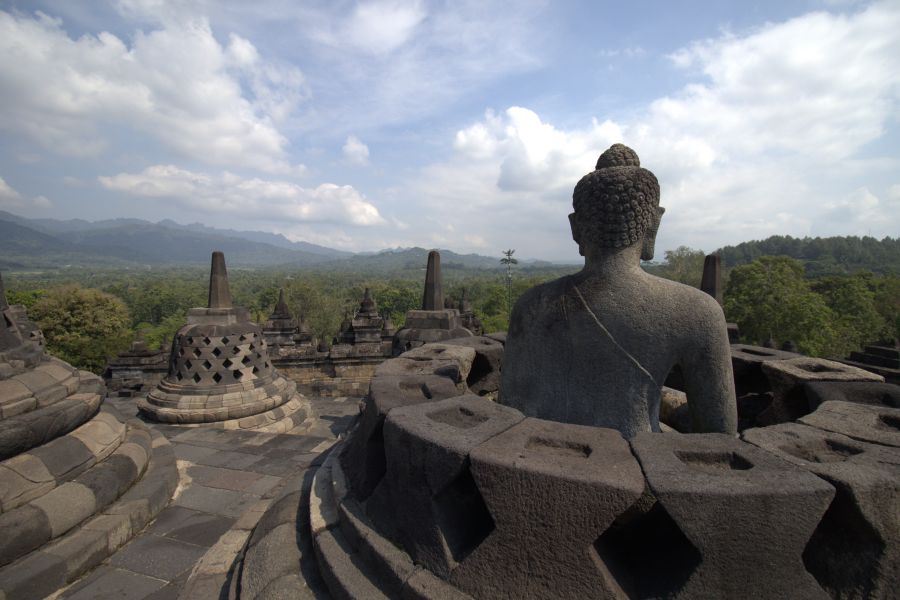
Borobudur is the other must-see UNESCO World Heritage Site that’s easily reachable from Yogyakarta. It’s not only the largest Buddhist temple in the world, but also one of the most impressive architectural wonders in Southeast Asia. Built in the 9th century, Borobudur was later abandoned for centuries and eventually buried under layers of jungle and volcanic ash. It was rediscovered in the 19th century and has since been partially restored.

Even today, the temple’s surroundings have a mystical, jungle-like feel that gives you a sense of what it must have been like to stumble upon this ancient structure for the first time. The massive stone monument is made up of over 2.600 carved relief panels and more than 500 Buddha statues, arranged across nine stacked platforms.To preserve the structure, access to the upper levels has recently been restricted and only a limited number of visitors are allowed each day. Tickets can be purchased for 75.000 IDR (for access to the temple grounds only) or 455.000 IDR (around €24) for access to the upper levels with a guide.
Borobudur is located about 40 kilometers northwest of Yogyakarta and is most conveniently reached by Grab, taxi, or as part of a guided tour. Many tours combine Borobudur and Prambanan in one day, which is a convenient option if you’re short on time.
Mount Merapi
Mount Merapi is one of Indonesia’s most active volcanoes. We visited as a part of a GetYourGuide activity, which takes you around the volcano’s surrounding area to learn about the devastating 2010 eruption and its aftermath. As a bonus, you get a fun, bumpy jeep ride 😉
We’d say that the tour is a nice add-on if you have a free half-day in Yogyakarta, but for us, it didn’t quite make the cut for our Best of Yogyakarta list. And while it was definitely interesting to understand the role that volcanoes like Merapi play in Indonesia, the tour came with a bit of uneasy moments too. At some points, we were asked to pose cheerfully for photos in front of sites that were directly linked to the 2010 eruption, which claimed the lives of over 350 people. We understand that this is often a response to what many tourists expect, but it still felt a bit out of place given the context. That being said, the experience can still be insightful and help to better understand the region’s complex relationship with its active volcanoes. GetYourGuide also offers a night tour to witness lava from Mount Merapi, as well as a combination package that includes Prambanan, Borobudur and Mount Merapi.

Local Art & Culture
Yogyakarta is a city where art, history, and culture truly come alive. It’s especially known for batik, and if you’d like to give it a try yourself, Batik Winotosastro is one of the best places offering workshops. For contemporary art lovers, the Langgeng Art Foundation showcases various exhibitions by both local and international artists. And if you’re curious about traditional Javanese performance arts, head to the Sonobudoyo Museum in the evening to watch a mesmerizing Wayang Kulit (shadow puppet) show. Another must-see for art and culture lovers is the area of Kotagede, a charming historic neighborhood in Yogyakarta known for its traditional silver workshops, beautiful old Javanese houses and quiet alleyways.
Café Culture in Yogyakarta
Yogyakarta’s café scene is fueled by the city’s large student population and artistic spirit. You’ll find a large selection of from minimalist coffee shops to cozy hangout spots and creative spaces. Some examples include No. 27 Coffee, Simetri Coffee, Alien Coffee, Sisi Selatan Coffee or nutur Coffee Store & Roastery.

Vegan Restaurants in Yogyakarta
Here are our favorite (fully) vegan restaurants in Yogyakarta: Simple Plant Vegan Kitchen & Artspace, LN Fortunate Coffee, Padang Vegan Damai, Loving Hut Espress, Black Forest Cafe. Beyond these dedicated places, it’s possible to find a vegan dish in almost every restaurant or Warung. Our go-to meal: Nasi Goreng (specify without egg) with vegetables, and tempeh or tofu.

We’ve put together a full guide on being vegan in Indonesia, including a detailed list of our favorite spots in Yogyakarta. You can check it out here.
Accommodations in Yogyakarta
Our accommodation: We stayed in a lovely Airbnb in the outskirts of Yogyakarta, quiet and peaceful. The place provides a huge bedroom, an equipped kitchen, bathroom, and a lovely view on the rice fields in its backyard. Breakfast is included in the price and as a vegan, you have two options: Nasi Goreng (specify without rice) and Bubur Desa (traditional rice porridge, literally means “village porridge”).
If you prefer to stay in a more central location, Prawirotaman, the Kraton/Malioboro area and Mantrijeron or Tirtodipuran are all great options.
Getting Around in Yogyakarta
Getting around Yogyakarta is relatively easy and budget-friendly. Here are your options:
Hiring a Driver
Downloading apps like Gojek and Grab is a very convenient way to get around the city. They’re cheap, reliable and you have a fixed price and easy card payment (via the app). It’s perfect for short rides across town or reaching places like Prambanan or the airport. For day trips (which will include multiple stops, for example visiting Borobudur, then Prambanan), hiring a private driver is a great stress-free option. Many accommodations or cafés can connect you with a local driver.
What also happens quite often in Yogyakarta is that your Gojek or Grab driver will offer you their contact details after the ride, suggesting to book them directly for future trips. This way, both sides save on app fees, and you’ll usually get a fair, fixed price. If you had a good feeling with your driver, there’s really nothing speaking against this option. And you can always double-check the standard fare on the app beforehand to know what price to expect. We can wholeheartedly recommend our driver Doddy, whom you can reach via WhatsApp at +62 81339809008. He was extremely reliable, always on time (even showing up 10 minutes early for a 6am pickup!) and genuinely kind. If you choose to drive with him, please let us know in the comments! 🙂
Scooter Rental
If you’re comfortable driving yourself, renting a scooter is a convenient and flexible way to get around. Rentals usually cost around 70.000-100.000 IDR per day. But keep in mind that traffic in Yogyakarta can be hectic, with lots of motorbikes, unpredictable drivers and narrow streets. If you’ve never driven in Indonesia before, Jogja might not be the best place to start.

Public Transport
Trans Jogja buses can be a great budget-friendly option, especially if you want to experience the local life and are not in a rush. Routes cover major areas including the airport, Malioboro, and Prambanan. Tickets are incredibly cheap and buses run frequently throughout the day.
On Foot
In certain neighborhoods like Prawirotaman, Mantrijeron, or Malioboro, walking is a great way to explore cafés, batik shops and local life. Sidewalks can be uneven or missing, but it’s still manageable in central areas.
FAQ: Visiting Yogyakarta
Is Yogyakarta worth visiting?
Yes! Yogyakarta (or Jogja) is considered the cultural heart of Java and one of Indonesia’s most fascinating cities. It’s the perfect base to explore iconic temples like Borobudur and Prambanan, while also enjoying vibrant street life, markets, royal heritage, and a growing vegan food scene. The city combines history, creativity, and affordability, making it an excellent destination for all kinds of travelers.
What are the must-visit attractions in Yogyakarta?
Top highlights in and around Yogyakarta include:
- Kraton (Sultan’s Palace): The cultural and political center of Javanese tradition.
- Taman Sari Water Castle: Historic retreat and bathing complex for the Sultan’s family.
- Malioboro Street: Famous for shopping, batik, street food, and vibrant nightlife.
- Prambanan: UNESCO World Heritage Hindu temple complex.
- Borobudur: The world’s largest Buddhist temple and one of Southeast Asia’s greatest landmarks.
- Kotagede: Historic neighborhood known for silver workshops and Javanese houses.
How do you get around Yogyakarta?
Getting around is easy and affordable. Apps like Grab and Gojek are the most convenient for short rides. For day trips to Borobudur or Prambanan, hiring a private driver is stress-free. Scooters are available for rent (70,000–100,000 IDR/day) if you’re confident with traffic. Trans Jogja buses are a cheap and reliable option, while neighborhoods like Prawirotaman and Malioboro are great for exploring on foot.
Is Yogyakarta safe for tourists?
Yes. Yogyakarta is generally safe for solo travelers, including women. Locals are friendly, scams are rare compared to other tourist destinations, and crime rates are low. Normal travel precautions apply—keep valuables secure and be cautious in heavy traffic.
What’s the food scene like in Yogyakarta for vegans?
Yogyakarta has a surprisingly good vegan scene! There are fully vegan restaurants such as Simple Plant Vegan Kitchen & Artspace, LN Fortunate Coffee, and Padang Vegan Damai. Many other restaurants and warungs can adapt dishes easily—just ask for nasi goreng tanpa telur (fried rice without egg) or try tempeh and tofu-based dishes, which are Javanese staples. Don’t miss vegan cendol made with coconut milk!
Where should I stay in Yogyakarta?
For a peaceful stay, Airbnbs outside the city with rice field views are a great option. If you want to be in the center of the action, areas like Prawirotaman, Malioboro, Kraton, and Mantrijeron are ideal. These neighborhoods are walkable, with plenty of cafés, shops, and restaurants nearby.
Further Reading
Blog Articles
- Best of Java: Your Ultimate Guide to Temples, Volcanoes & Vegan-Friendly Travel
- Vegan in Indonesia: The Ultimate Guide For Bali, Java and Lombok
- How to Spend 1 Day in Jakarta: Quick Guide to Exploring the Capital
- Mount Bromo from Probolinggo: Sunrise Adventure and Practical Tips
Useful Resources

About the Authors
Lynn & Daniel are the vegan couple behind VanderlustJourney, combining their passion for adventure and plant-based living. They share stories and visuals of natural places, hikes, vegan discoveries, and meaningful encounters from around the world – always striving to travel with kindness.
👉 Follow us on Instagram
✉️ Contact: vanderlustjourney@outlook.com