
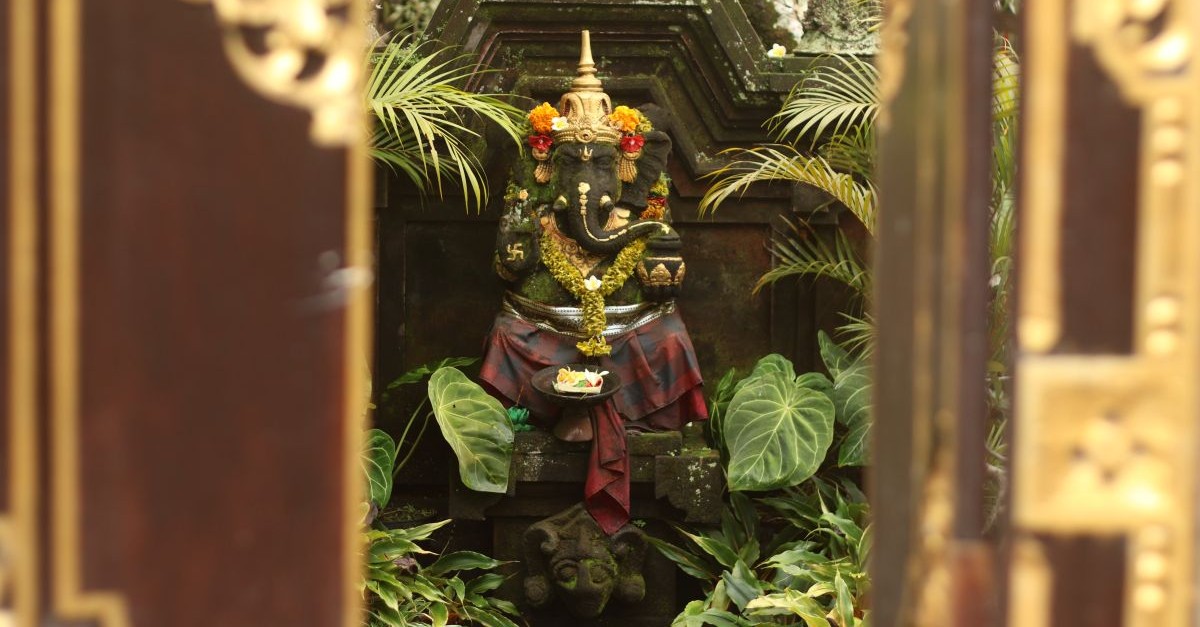
Welcome to a fascinating exploration of spirituality in Bali, the Indonesian island known as the Island of the Gods. While many travelers come to Bali for the natural beauty or nightlife, there is also another, quieter side, much harder to put into words: the island’s unique energy and spirit. And those who have felt it often say it’s the reason they return, again and again.
An Island with Many Faces

Bali has become one of the most well-known travel destinations in recent years, attracting visitors from all over the world for different reasons. Some come for the beautiful beaches, others for the party scene that has especially developed in the south of the island. And it’s particularly this second aspect that makes some people almost frown upon Bali nowadays. You hear voices saying that “traditional Bali” is gone, that the place is no longer authentic, that it has been overrun by tourism. That there are “better islands” out there. For us, it’s mostly a sign of our fast-living, consumerist society – as if you could just move on to another island, untouched by tourism, and make it the “new Bali”. As if you could pack up the people, the thousand-year-old traditions, the culture, … put it all in a suitcase, load it onto a ferry, and bring it somewhere else.

But beyond the landscapes and party culture, there is something else about this small island that makes it so unique and outstanding. Something that can’t be copied or simply relocated, because it’s deeply woven into the lands – we found no better way to describe it than the spirit of the island.
The way offerings are laid out every morning with care and intention. The ceremonies that take place not for show, but because it has been that way since thousand of years. The scent of incense wafting through the streets. The ever-present connection between the visible and the invisible, between daily life and the divine.
Spirituality in Bali is deeply rooted in the island’s history and a part of everyday life. We’ve encountered more than one traveller that told us about how they can feel this unique energy whenever they are here, or at least they feel that something is missing as soon as they leave Bali. And how it makes them return, again and again.
The History of Religion and Spirituality in Bali
If you travel through Indonesia and visit a few islands, one fascinating fact about Bali stands out very quickly: while the vast majority of Indonesian islands are Muslim, this small speck of land has its own distinct religion – and it has been that way for over a thousand years. The dominant religion is Balinese Hinduism, a unique blend that incorporates Hindu elements, Buddhist philosophy, animism and ancestral worship. Arriving in Bali from Java, we found it fascinating to see how Buddhism shapes the landscape, architecture, and rituals.
But how has Bali managed to stand alone like this for so long? Geography played a key role: as a small island, Bali remained relatively isolated, allowing its local traditions and religious practices to evolve without being fully absorbed by the dominant forces shaping the rest of the archipelago. When Islam spread through Java and other islands from the 13th century onward, many Hindu nobles, priests, and artisans fled eastward to Bali, bringing their spiritual practices with them. The Balinese people adapted these traditions, deeply rooted in daily life, community structure, and a worldview that ties the spiritual to the natural world. And they have remained faithful to these practices ever since. No matter how chaotic or commercial some parts of Bali may feel today, especially in the more touristic areas, you’ll always find someone lighting incense, placing an offering or pausing for a prayer.

Balinese Spirituality

The religion and spirituality in Bali can be described as a blend of hindu-buddhist traditions, animism (the belief in the souls of all things in nature) and a deep respect of nature. People believe in multiple gods and goddesses, with Brahma, Vishnu and Shiva (the Trimurti) being the three central ones. Spirits are found everywhere in nature, in the form of animals, trees, rivers and mountains, while the spirits of the ancestors guide and protect their family members. Through daily offerings, the “canang sari”, gratitude and devotion are expressed towards the gods, spirits and ancestors. The concept of “Tri Hita Karana” (translated as “the three causes of prosperity and happiness”) promotes the harmonious relationship between humans, nature and the divine and can be found in every area of life in Bali, such as architecture for example.
Canang Sari
Spirituality in Bali is perhaps nowhere more visible to the untrained eye than in the “Canang sari”, daily offerings found everywhere across the island. They are placed in front of temples, doorsteps, restaurants, even on scooters or at the start of hiking paths. Each offering consists of a small, handwoven leaf tray filled with flowers, fruits, often rice, and sometimes cookies or wrapped sweets. A stick of incense is always added and lit, as the rising smoke is believed to carry the essence of the offering to the gods.
We loved observing this sacred ritual, which felt incredibly intimate, yet is performed every day on the streets across the island: the women, sometimes also men, place the offering on the ground, then light a stick of incense and gently wave it over the tray. Sometimes, they also sprinkle holy water over it. This is followed with a moment of silent prayer to the gods, ancestors or spirits. Spirituality in Bali is part of the rhythm of daily life. Even in the busiest corners of town, these small acts of devotion bring a sense of presence and peace.

Temples

One of the first things we noticed traveling from Java to Bali were the temples everywhere, and we mean truly everywhere. Every traditional Balinese household has its own family temple, known as a sanggah or merajan. Usually located in the northeast corner of the compound (considered the most sacred direction), this small temple is used for daily offerings and family rituals. Here, the family honors their ancestors, placing offerings such as canang sari each morning.
Then there are the public temples (pura) that host village ceremonies, religious festivals and seasonal rituals. Each temple serves a specific spiritual function, such as Pura Desa (the village temple) to honor protective spirits of the community, or Pura Puseh dedicated to the ancestors of the village.
Ceremonies
The Balinese year is incredibly rich in ceremonies, each with its own meaning. One of the most important is Nyepi, the Day of Silence, which marks the Balinese New Year with a full day of stillness, reflection, and complete shutdown – even the airport closes. The night before, the streets come alive with the Ogoh-Ogoh parade, where giant, demon-like statues are carried through the streets and then symbolically burned to drive away negative spirits.
Other major ceremonies include Galungan, a ten-day festival celebrating the victory of dharma (good) over adharma (evil), where decorated bamboo poles (penjor) line the streets. It ends with Kuningan, a day to honor ancestors. Another deeply symbolic ritual is Melasti, held a few days before Nyepi, where villagers walk in procession to the sea to purify sacred objects and cleanse the spirit.
Purification
“Melukat” comes from the balinese word “lukat”, meaning cleaning and purifying of body, mind and soul. It’s performed at holy springs, temples or rivers to cleanse the body and soul from negative energy, stress, or bad luck. The most well-known (and therefore also quite busy) place to experience this is Tirta Empul Temple near Ubud, which has attracted a growing number of visitors in recent years. Personally, we chose not to visit Tirta Empul, as to us the overly touristic atmosphere didn’t feel like the right setting for such a sacred and personal ritual.
Yoga
Although Yoga as a physical practice is not part of traditional Balinese culture, more and more yoga studios have been popping up in recent years, especially in Ubud. Many of them are heavily western-influenced and primarily attended by expats, and while prices may seem cheap compared to those in Western countries, they are often unrealistic for local Balinese people. There are some extremely popular studios, such as Yoga Barn or Radiantly Alive Yoga (pictured on the right), which offer daily classes, workshops and teacher trainings. These spaces have a beautiful setup and are professionally run, but they do cater largely to the international wellness crowd.
However, beyond these big international names, it is also possible to find smaller (and maybe more authentic?) places, run by local teachers. We took a class at Griya Heart Yoga & Meditation Centre, and especially Lynn had a very positive experience, connecting with the session in a way that hadn’t happened in bigger studios. We share more about this special place below.

Healers
Healers in Bali, often referred to as “Balian”, are an important part of traditional Balinese culture and spiritual life. While some gained global attention (especially after Eat Pray Love), their role is far deeper and more community-rooted than many realize. They’re consulted for everything from physical illness to emotional struggles or bad luck. Healing may involve herbs, massage, mantras or purification rituals like melukat. If you’re curious, visiting a healer can be a powerful experience, but we think that it’s important to approach it with respect, ideally through local recommendations, and not as a tourist attraction.
Our Recommendation
During our stay in Ubud, we discovered Griya Heart Yoga & Meditation Centre, and it turned out to be one of our favorite experiences in Bali! We joined a yoga session together for 150.000 IDR, which felt super affordable, especially since it was just the two of us. Then, we each had a private palm reading.


The word “Griya” means “spiritual home” and that’s exactly what this place felt like. The centre is run by Dayu, an energetic and kind-hearted woman, who welcomes you with a big smile. Though it’s just a few minutes away from Ubud’s busy main street, stepping inside feels like entering another world. It’s a truly peaceful sanctuary with a beautiful garden, a pond with ducks and the sound of cicadas – just arriving there already makes you feel good. Dayu accompanied the yoga session with sound healing, and she also offers reiki and chakra balancing, while her husband guides meditation sessions.
Our yoga session was “simple”, meaning no fancy poses, and focused on opening the body and heart. I (Lynn) don’t know whether it was the shoulder and heart-opening stretches, the singing bowls or simply the magical atmosphere of the place, but I’ve never experienced such a strong energetic presence during savasana. On top of that, Dayu constantly reminds you to smile, claiming that your body is more flexible when smiling 😉 Not sure how true that is, but what’s sure is that I’ve never found myself giggling in such a lighthearted way during a Yoga class before.
If you want to experience Dayu’s magic, you can find her address here. To contact her, simply write a whatsapp message to +62 81936203001. And please tell her hi from Lynn and Daniel 😉
Further Reading
Blog Articles
Useful Resources

About the Authors
Lynn & Daniel are the vegan couple behind VanderlustJourney, combining their passion for adventure and plant-based living. They share stories and visuals of natural places, hikes, vegan discoveries, and meaningful encounters from around the world – always striving to travel with kindness.
👉 Follow us on Instagram
✉️ Contact: vanderlustjourney@outlook.com
A wonderful post. In spend a lot of time in Lombok, which a lot of people refer to as the “new Bali” or the “next Bali” but the culture is so different it can’t really compare. Yes, it has the wonderful Indonesian way of life, beautiful beaches and lush rice paddies but I guess it depends what you’re looking for in Bali. I’m so glad you found a way to have a beautiful time on Bali.
Thank you! We went to Lombok right after Bali and I totally agree with you that the two islands are very different. But each wonderful in their own way 🙂