Slowboat from Thailand to Laos: The Ultimate Guide with Vegan Tips
The Mekong River, stretching nearly 5,000 kilometers, is the lifeline of Southeast Asia. Flowing through six countries before reaching the South China Sea, it shapes landscapes, cultures, and daily life along its banks. Starting from Thailand’s border, a trip on the slowboat from Thailand to Laos gives you the chance to follow this journey for a short while. Over two peaceful days, you’ll drift along its natural course, passing Laos’ green hills, remote villages, and untouched landscapes. It’s a true immersion in nature and an invitation to slow down.In this post, we hope to share the beauty of this journey with you – all while answering your practical questions, providing an overview of the route, accommodation advice, and guidance on how to survive as a vegan along the way.
This post contains affiliate links. If you make a purchase or booking through these links, we earn a small commission at no extra cost to you. This supports our work and allows us to keep offering free content here on the blog.
Laos
Laos (Lao PDR) is a small, landlocked country in Southeast Asia, bordered by Thailand, China, Cambodia, and Vietnam. Shaped by the mighty Mekong River, it’s a land of mountains, jungles, and waterfalls where life flows at a slower pace. Known for its Buddhist temples, French colonial influences, and warm hospitality, Laos offers travelers a chance to step off the beaten path. From UNESCO-listed Luang Prabang to remote river villages, it’s a destination that blends natural beauty, rich culture, and charm.
Mekong River
The Mekong River is defined as one of the great rivers of the world, for its vast ecosystem and cultural heritage, shaping life in Laos. Flowing nearly 5,000 kilometers through six countries – China, Myanmar, Thailand, Laos, Cambodia, and Vietnam – it plays a central role in the lives of the Lao people. The river provides food, shapes landscapes, and carries centuries of history and tradition. Along its banks, you’ll find fishing villages and fertile rice fields, all deeply connected to and dependent on the river’s rhythm.
The Mekong River plays an important part in the lives of Lao people.
Journey by Slowboat to Laos
History
For centuries, the Mekong River was the main way of travel in Laos. Roads were scarce and difficult through the mountains, so wooden longboats powered by small engines (or earlier, by oars and sails) were the natural way to move people and goods. The 2-day journey from Huay Xai to Luang Prabang, that connects the Thai border (Huay Xai, opposite Chiang Khong) to Luang Prabang, the cultural capital of Laos, was used frequently by traders, locals, and monks commerce, temple visits, and family ties. From the 1990s onward, as Laos opened more to tourism, travelers discovered that joining the local slowboats was a scenic, affordable and exciting way to enter the country.
Traveling by slowboat to Laos has a long history.
Overview of the Route
The official slowboatto Laos route takes two days, starting in Huay Xai (on the Thai–Laos border) and ending in Luang Prabang. For most travelers coming from Thailand, however, the journey begins much earlier. Many start in Chiang Rai (point A on the map), before taking a bus and tuk-tuk to the border, crossing into Laos, and hopping on a tuk-tuk to reach their first overnight stay in Huay Xai(point B).
From there, the adventure truly begins. The next morning, you’ll board the slowboat and spend the day drifting down the Mekong until reaching the riverside town of Pakbeng(orange) in the late afternoon. After an overnight stay, the journey continues the following day, with the boat finally arriving in the UNESCO World Heritage town of Luang Prabang(red).
Start in Thailand
Most travelers starting the slowboat journey to Laos begin in Chiang Rai, Thailand. From there, the easiest way to reach the Thailand–Laos border is by public bus. Head to Chiang Rai Bus Terminal 1 and look out for the red bus labeled Chiang Rai – Chiang Khong (the Thai side of the border). Buses depart roughly every 30 minutes, with the earliest at 7:30 AM and the latest around 4:30 PM (double-check before you go, as timetables can change). We recommend leaving during the first half of the day to have enough time for border crossing. The bus ride usually takes around 3-4 hours. Often, the last stretch is done by tuk-tuk, but the bus crew will inform you in this case.
Chiang Rai in Thailand is where most travelers start their journey to Laos.
Once at Chiang Khong, you’ll cross the border into Huay Xai, Laos, completing customs and immigration formalities. From there, a short tuk-tuk or local bus will take you to your accommodation in Huay Xai, where you’ll spend the night before boarding the slowboat the following morning. This first leg is straightforward, but it’s recommended to allow enough time for border procedures and to book your Huay Xai stay in advance, especially during the high season.
What you need:
Bus ticket (can be bought directly on the bus)
Passport
Cash in Thai Baht or US Dollars
Passport photo (if you have one)
Huay Xai
Once in Huay Xai (sometimes spelled Huayxay or Houay Xay), you’ll have the rest of the day to explore, walk around, and rest. We decided to head to the pier and purchase our slowboat tickets for the next morning. Note that you receive one ticket for both days, which will be collected on day two, so keep it safe with you.
View on Buddha statue in Huay Xai.
After spending the night in Huay Xai, board the slowboat in the morning, usually between 8:00-9:00 AM. Even if your ticket has a seat number, in our experience, people often sit wherever they like. The boat ride follows the Mekong River through stunning landscapes, with rolling hills, forests, and riverside villages. Occasionally, you might spot water buffalo, cows, or even monkeys along the riverbank. Expect around 6-8 hours on the river, depending on water levels and stops. Late in the afternoon, the boat arrives in Pakbeng, a small riverside town where you’ll spend the night.
Pakbeng
Pakbeng is a quiet and charming riverside town, with simple guesthouses and local restaurants. Most travelers use it merely as a stopover on their slowboat journey to Luang Prabang, and the little village is perfectly equipped for that; offering cozy rooms for overnight stays and even take-away dishes for the next day on the boat. In their article, Adventures of Jellie raised the question: what to do in Pakbeng if you actually stay for a full day? And the answer is: plenty! We invite you to check their recommendations out here.
For the majority of travelers, however, the journey continues the next morning, usually around 9:00 AM. Be sure to confirm the exact departure time, as it can vary, and it’s wise to arrive a little earlier. During our stay, a timetable at the pier said the boat leaves at 9:30 AM. A hotel staff member told us 9:15 AM. Finally, when we showed up around 8:30 AM (trying to grab the good seats!), the boat was already mostly full and left 20 minutes later. Oops! At least, had we missed it, we could have tried following Adventures of Jellie’s Pakbeng itinerary ourselves 🙂
Cows along the Mekong riverside.
The journey to Luang Prabang takes another 6-7 hours. Some travel blogs suggest that this second day on the slowboat is less exciting, as the thrill of the new experience has worn off and most people are simply eager to reach their final destination. Personally, we continued to enjoy the ride, equipped with a good book and pre-downloaded podcasts. Some passengers also passed the time playing cards.
Along the way, the slowboat occasionally stops at small riverside villages. Sometimes locals disembark, while in other cases, villagers approach the boat for what seems like trading, selling, or buying food and provisions.
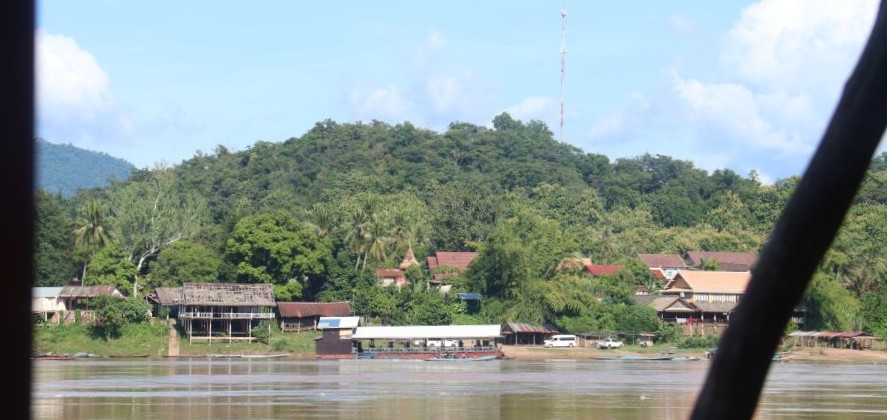
Riverviews.
In the late afternoon, the slowboat arrives in Luang Prabang – or more precisely, about 7 km from the UNESCO-listed town. From there, you’ll need to take a tuk-tuk, which you can share with other travelers, to reach your accommodation.
Luang Prabang
Once in Luang Prabang, you’ll immediately notice the charm of this UNESCO World Heritage town. Located between the Mekong and Nam Khan rivers, the city is famous for its well-preserved French colonial architecture, temples, and laid-back atmosphere. After the slowboat ride, it surely feels good to stretch your legs and wander along the riverbanks, explore local markets, or grab a coffee at one of the riverside cafés. If you arrive in the late afternoon, you can still catch the night market, which offers a colorful selection of handicrafts, souvenirs, and street food (more on vegan food options below!).
The sky in Luang Prabang welcomes us with a bang!
Luang Prabang is also the perfect base for exploring the surrounding area. Popular excursions include visiting Kuang Si Waterfalls or taking a boat trip to the Pak Ou Caves.
Best things to do in Luang Prabang
Read our detailed guide to discover the
best things to do in Luang Prabang
– from magical waterfalls and golden temples to cozy vegan cafés and riverside sunsets.
Slowboat to Laos for Vegans
Admittedly, we were a bit dramatic with our opening question on how to survive as a vegan on the slowboat to Luang Prabang. The short answer: surprisingly well! The long answer: luckily, Lao cuisine is quite vegan-friendly, and all it takes is a bit op preparation. But since the towns along the route are used to catering to travelers, you’ll not only find satisfying meals on-site but can also easily grab take-away for the next day’s boat ride.
Enjoying a sandwich with tofu and veggies on the slowboat to Luang Prabang.
For a deeper dive into Laos’ food culture, we invite you to check our article Vegan in Laos (coming soon).
Vegan in Huay Xai
Most restaurants in Huay Xai have similar menus and so you’ll find mostly the same vegan options everywhere.
We had dinner at Mae Da Restaurant, which was one of the cheaper options and provided tasty, filling meals. They even prepared a tofu and salad sandwich for us to take along on the boat the next day.
In Pakbeng, we ate at Alisa, a small local restaurant with a whole separate vegan section! We also ordered our sandwiches for the next day, which included tofu, veggies and avocado.
Luang Prabang has a growing vegan scene, offering everything from local Lao dishes to international cuisine:
Vegetarian & Vegan Buffet: Stand at Luang Prabang’s night market with fully vegan options (the stand is located next to and associated with a meat and fish vendor though). For just 50,000 LAK, you can fill your plate as much as you like with a variety of dishes, including different types of rice, noodles, curries, tofu, and vegetables. The food isn’t served very hot, but it’s flavorful, satisfying, and a great affordable vegan option!
Fully vegan plate with curry, pasta, tofu and lots of greens.
Happy Cat Café: A cozy vegetarian spot serving delicious plant-based meals, vegan twists on local dishes, fresh smoothies, and coffee. Perfect for breakfast, lunch or dinner. The café supports sterilization, vaccination and care of cats in need and the animals are free to wander in and out as they wish.
Two Little Birds Café: Fully vegetarian café with lots of vegan options. Greatfor healthy bowls, local Lao dishes, smoothies and snacks.
Khaiphaen Restaurant: A socially conscious restaurant dedicated to help underprivileged young kids, with vegan options.
Yuni Yupoun: Restaurant with several well-marked vegan options from different cuisines, such as Mezze Platter, fried eggplant, curry and burger (bun contains milk; but they can serve it with pita bread). Creative and nice atmosphere.
Mezze platter.
Fathima: Indian & Malaysian restaurant with river view and lots of vegan options.
Lost In Baan: Asian fusion restaurant with creative vegan options.
Additional Vegan Tips
Even if a menu doesn’t specifically mention vegan options, that doesn’t mean there aren’t any. Personally, we like to check Google Maps reviews (simply search for “vegan” and see what comes up for nearby restaurants) to learn from other vegans’ experiences. To be safe, always ask if a dish can be made without fish sauce, oyster sauce, or shrimp paste (Baw mee nam pa, baw mee nam sut hoi, baw mee kape hoi).
Vegan Sandwich
When ordering sandwiches or bánh mì, always specify no sauce, as they often include mayonnaise or other dairy-based spreads.
For full vegan safety, also ask for no fish sauce, no oyster sauce, no shrimp paste (Baw mee nam pa, baw mee nam sut hoi, baw mee kape hoi).
Vegan Translation Card
A useful card to always have with you; feel free to save, screenshot or print it for your travel to Laos.
Accommodations in Laos
Where to stay in Huay Xai
We stayed at Sabaydee Guesthouse, which was ideal for one night. It features a basic, but clean and cozy room, and a terrace (shared with the rest of the guesthouse) with a great view on the Mekong river, perfect for daydreaming about your slowboat journey ahead. To reach the pier, it’s a 15-20 minute walk from the guesthouse.
Enjoying the view on the river and Buddha statue from our accommodation.
Other accommodation ideas:
1 Min to Slowboat Guesthouse: Very convenient guesthouse, close to the pier and they can arrange boat tickets and refreshments for guests.
Where to Stay in Pakbeng
We stayed at Mekong Riverside Lodge, a wonderful accommodation right on the Mekong River. The rooms are spacious and we had a balcony that comes with a beautiful view on the water. We almost wished we had booked one additional night, just to enjoy the peaceful atmopshere a bit longer 😛 Breakfast is included, the vegan option during out stay was toast, jam and fruits.
Yoga in the morning with view on the river.
Other accommodation ideas:
Le Grand Pakbeng: Bungalows and villas with an infinity pool offering stunning views over the Mekong River. This seems to be the ideal accommodation to stay one day longer in Pakbeng, to relax from the long boat ride and make the most of the facilities.
The Sanctuary Pakbeng Lodge: Another stay with pool and river view. Guests report that elephants from the sanctuary nearby can be observed bathing in the river in the morning.
Where to Stay in Luang Prabang
We stayed for a few days in Le KhounSok Boutique Hotel, which provided a clean and comfy room. For breakfast, they prepared vegan banana pancakes on request, while fried rice was also an option.
Some riverside accommodations in Luang Prabang offer great sunset views.
Maophasok River Side Hotel: Very affordable hotel with clean rooms and, depending on room type, a balcony and river view.
Practical Tips
Best Time to Travel
The Mekong slowboat runs year-round, but the experience can differ depending on the season. August is typically the wettest month, which can mean heavier rains and muddier paths in riverside villages. That said, the weather in Laos is never fully predictable: we traveled in September, and it barely rained at all during the day (only at night), so the journey was very pleasant. The dry season (November-March) is the most popular with travelers thanks to cooler temperatures and more stable weather, but shoulder months like September or October can also be a great time to go, with fewer crowds.
Costs for Slowboat to Laos
Here’s an overview of the typical expenses (prices in euros). Note that in Laos, the common currencies used are LAK (Lao Kip), Thai Baht, and USD – with a clear preference for US Dollars, especially for visas and official fees.
Estimated Expenses: Slowboat to Laos
Expense
Cost/person (approx.)
Notes
Visa on Arrival for Laos
~€38
≈ $40 – must be paid in new, clean USD bills (can be exchanged at desk where you purchase bus tickets over Friendship Bridge)
Bus from Chiang Rai to Thai-Lao border + Tuk-tuk
~€3
To reach immigration at Chiang Khong
Bus across Thai-Lao Friendship Bridge
~€1
≈ 40 THB
“Administration fees” at Laos border
~€2–3
Unofficial, but commonly requested
Slow Boat ticket (2 days)
~€20–25 (400.000 LAK)
Huay Xai → Pakbeng → Luang Prabang
Accommodation in Pakbeng (1 night)
Starting from ~€8–10
Budget guesthouses
Tuk-tuk from Luang Prabang pier to town center
50.000 LAK (Tuk-tuk shared with 6 people)
Negotiate fare; typical cost around 50.000 LAK
Total Estimated Cost
~€65–70
Per person, excluding food & extras
What To Bring on Your Slowboat Adventure
Sun protection & insects: Bring sunscreen, a hat, and mosquito repellent.
Toilets on the slowboat: Facilities are often basic (but in our experience always clean), sometimes squat-style, and often with manual flush; bring toilet paper.
Snacks: There’s a small shop with drinks and snacks on board, but we didn’t check for vegan options. We recommend bringing your own snacks and sandwiches.
Cash: Have small change in USD or Lao Kip (LAK) for fees, snacks, or small purchases along the river.
Ticket counter before crossing the border that lets you buy bus tickets and exchange US-Dollars.
Planning Solo Vs. Guided Tour
Let us start by saying that organizing the slowboat to Laos independently is totally doable, and many travelers prefer it. Buying bus and boat tickets, crossing borders, and planning overnight stays might seem daunting at first, but if you take it step by step, it’s actually quite straightforward. Most of the information is online, and of course you can always ask your questions here in the comments 🙂
The local bus ride from Chiang Mai is part of the fun.
That said, if you’d rather skip the planning and just relax, a guided option like GetYourGuide can be a convenient choice. Their tours usually include tickets, transfers, and helpful tips for overnight stays (you still need to book the room by yourself!), so you can focus entirely on enjoying the scenery. On our slowboat journey, we met travelers who opted for this approach, and sharing the experience with a small group is also a fun way to meet fellow adventurers; especially if you’re traveling solo.
Even though we don’t think a guide is essential, for those who value convenience, it’s a great way to experience the journey without the stress of planning every step.
Beyond the Slowboat
Other Ways to Get to Luang Prabang
Besides the slow boat journey, there are a few other options (even though less fun in our opinion :D) for reaching Luang Prabang:
We loved the slowboat to Laos, but there are alternatives to reach Luang Prabang.
Fly to Luang Prabang: The fastest and most convenient way is to take a direct flight. Luang Prabang International Airport has connections to Bangkok, Hanoi, Chiang Mai, and other regional hubs. This is ideal if you’re short on time or want to avoid long bus rides.
By Bus or Minivan: Overland routes connect Luang Prabang with Vang Vieng, Vientiane, and the north (like Nong Khiaw). While inexpensive, the roads can be long and bumpy, so be prepared. We like to book our tickets in advance through 12Go.
By Train (to nearby cities): With the new Lao-China high-speed train, you can reach towns like Vang Vieng or Luang Namtha much faster, and then continue by bus or minivan to Luang Prabang.
How to Continue Your Journey from Luang Prabang
Luang Prabang is well connected to other parts of Laos, so it’s easy to continue exploring the country after your slowboat adventure. Depending on your time and interests, here are some common routes:
Nong Khiaw: A small village, that’s slowly becoming very popular among travelers seeking peace and nature. This small riverside town, surrounded by impressive limestone mountains, is about 4-5 hours away by minivan. Perfect for hiking, boat trips, and stunning viewpoints.
The small village of Nong Khiaw is a true beauty.
Vang Vieng: Once famous for its party scene, Vang Vieng is now better known for outdoor activities like kayaking, tubing, hiking, and hot-air balloon rides. The journey takes around 5-7 hours by bus or minivan, and only about 1h with the new high-speed train (Laos–China Railway).
Vientiane: Laos’ laid-back capital city, located further south, about 10-12 hours away by bus or minivan. We only spent one night here while passing through. While it’s not usually a traveler’s favorite destination, it’s still worth a short stop for its serene temples, riverside markets, and its overall slower pace compared to many other Southeast Asian capitals.
Is it Worth it?
While reading this article, one question might have crossed your mind: Is it worth it?Personally, we believe the answer depends on each traveler’s preferences. On this type of travel, the slowboat isn’t just a means to reach Luang Prabang, it’s about the journey itself.
The journey on the Mekong River is an invitation to slow down.
It’s about slowing down and noticing the subtle shifts in landscapes, colors, and vegetation as you drift along the river. About having a glimpse into small villages and children living a life so different from your own, moments you would never witness otherwise. About leaning back with a good book or finally listening to that audiobook you’ve been meaning to finish. About sharing the ride with locals who have traveled this route countless times and soaking in their everyday rhythm.
And honestly, we think you already know the answer for yourself. If reading this, the thought crossed your mind that you could just take a bus or fly, then go ahead and do so. But if these words and pictures sparked even a little rush of excitement, then this journey is for you!
This guide is completely free. If it helped you plan your trip and you’d like to say thank you, you can do so here 🙂
The slowboat is a 2-day journey along the Mekong River from Huay Xai (Laos border) to Luang Prabang. It passes riverside villages, lush landscapes, and provides a unique slow-travel experience.
How long does the slowboat journey take?
Approximately 6–8 hours per day over 2 days, with an overnight stop in Pakbeng.
When is the best time to take the slowboat?
The dry season (November–May) is ideal, with stable river levels and comfortable weather.
What should I bring on the slowboat?
Bring sunscreen, a hat, mosquito repellent, snacks, water, and a cushion for comfort. Cash in USD or LAK is useful for small purchases along the river.
Are toilets available on the slowboat?
Yes, but they are often basic and squat-style. Facilities are usually clean but simple, sometimes with manual flush.
Is the slowboat journey vegan-friendly?
Yes! Lao cuisine is very plant-based friendly, and most stops have restaurants offering vegan meals. For full safety, ask for no fish sauce, oyster sauce, or shrimp paste.
Where should I stay along the slowboat route?
In Huay Xai: Sabaydee Guesthouse or 1 Min to Slowboat Guesthouse. In Pakbeng: Mekong Riverside Lodge, Le Grand Pakbeng, or The Sanctuary Pakbeng Lodge. In Luang Prabang: Le KhounSok Boutique Hotel, Dawn Boutique, or My Dream Boutique Resort.
Other ways to reach Luang Prabang?
You can also fly, take a bus, or travel via the new Lao-China high-speed train combined with a bus. However, these options are less scenic and slower in immersion compared to the slowboat.
Is the slowboat journey worth it?
The slowboat is more than just transportation. It’s about slowing down, observing shifting landscapes, riverside villages, and daily life along the Mekong. It’s about leaning back with a book, sharing time with locals, and experiencing a rhythm you wouldn’t encounter otherwise.
Journey vs. Destination
The slowboat isn’t just a way to reach Luang Prabang—it’s about the journey itself. Drift along the Mekong, notice subtle changes in landscapes, watch riverside villages and children at play, lean back with a good book, or simply soak in the rhythm of local life. If reading this sparks even a little rush of excitement, then this journey is for you.
For those looking for more unconventional journeys in Southeast Asia, check out our other articles on off-the-beaten-path adventures, hidden gems, and unique slow travel experiences:
Lynn & Daniel are the vegan couple behind VanderlustJourney, combining their passion for adventure and plant-based living. They share stories and visuals of natural places, hikes, vegan discoveries, and meaningful encounters from around the world – always striving to travel with kindness.
7 thoughts on “Slowboat from Thailand to Laos: The Ultimate Guide with Vegan Tips”
What an evocative journey you’ve shared! 🌿 Reading about your slow boat to Laos made me feel like I was drifting along beside you, soaking up the landscapes, the quiet moments, and the transitions between places.
I love the pictures of the food—it looks so good! They really capture the feeling of slowing down and enjoying the journey, just like you described with the boat ride. The way you mixed in vegan tips makes it even more helpful.



What an evocative journey you’ve shared! 🌿 Reading about your slow boat to Laos made me feel like I was drifting along beside you, soaking up the landscapes, the quiet moments, and the transitions between places.
Aww, thank you so much!
This looks like such an amazing trip! Glad you were able to find plenty of vegan options.
Thank you Chloe!:)
This sounds incredible! Giving me the travel bug!!
I love the pictures of the food—it looks so good! They really capture the feeling of slowing down and enjoying the journey, just like you described with the boat ride. The way you mixed in vegan tips makes it even more helpful.
Thank you Ann! 🙂