
We recently embarked on an Atacama to Uyuni tour across the world-famous Bolivian Salt Flats (Salar de Uyuni), and of course, we stayed true to our vegan values every step of the way. Starting in San Pedro de Atacama, Chile, we were both excited and a little nervous about how we’d manage a plant-based diet, especially in such remote Andean landscapes. What we can already reveal: this journey took us through some of the most beautiful, surreal landscapes we’ve ever encountered in South America… and yes, we actually ate well! We enjoyed meals with our group, adjusted to the high altitude, and created memories we’ll never forget. In this guide, we’ll share our exact itinerary, what it’s really like doing this tour as a vegan, and everything you need to know before booking your own Atacama to Uyuni tour.
For full transparency: we paid for this tour out of our own pocket and are not being compensated in any way for this review. All thoughts are our own.
Introduction
- Best for: Surreal landscapes, high-altitude deserts, colorful lagoons, and the world’s largest salt flat
- Route: San Pedro de Atacama (Chile) through the Eduardo Avaroa Reserve to Salar de Uyuni (Bolivia)
- Getting around: Guided 4×4 Land Cruiser tours (essential for navigating unmarked terrain)
- When to visit: May-Oct (dry season, classic white hexagons, cold nights); Dec-Apr (wet season, giant mirror effect)
- Fees & Cash: Bring cash (Bolivianos) for border taxes, entrance fees, and bathrooms
- Connectivity: Almost no cell service or Wi-Fi for the majority of the 3-day journey
A multi-day off-road adventure through remote and breathtaking Andean scenery and one of the most surreal places on earth
This post contains affiliate links. If you make a purchase or booking through these links, we earn a small commission at no extra cost to you. This supports our work and allows us to keep offering free content here on the blog.
Atacama to Uyuni Tour: Why is it so Popular?
So why does nearly every traveler in South America have the Atacama to Uyuni route on their bucket list? And why experience it as part of a tour? The answer is simple: there is almost nowhere else on Earth where the landscapes are this otherworldly and shift so dramatically in such a short span of time.
In just three days, you travel through some of the most remote and surreal environments on the planet. The journey begins in the deep red, Mars-like deserts of the Atacama, continues past high-altitude lagoons home to thousands of pink flamingos, and ends at the blindingly white, surreal expanse of the Salar de Uyuni. There are no paved or marked roads here and no reliable maps. Instead, you cross the vast Altiplano in a sturdy 4×4 Land Cruiser, completely disconnected from cell service and Wi-Fi. It’s an adventurous, dusty, and authentic way to experience the wild heart of the Andes.

Choosing Your Route
Starting in Atacama vs. Starting in Uyuni
You can do this tour in either direction: starting in San Pedro de Atacama (Chile) and ending in Uyuni (Bolivia), or vice versa. Both routes visit the exact same mind-blowing sights, just in reverse order.
- Atacama to Uyuni: We chose this route because it naturally fit our travel itinerary heading north through South America. A bonus of this direction is that the landscapes build in climax, saving the actual Salar de Uyuni for the end. In this article, we’ll present our tour in this direction, but of course, the tips remain the same if you start the tour from Uyuni.
- Uyuni to Atacama: If you are traveling south from Peru or La Paz, you will likely start in Uyuni. Just keep in mind that Uyuni sits at a higher starting altitude than San Pedro de Atacama, so acclimatizing for a few days beforehand is extra important! From what we’ve heard, tours are often cheaper when you book them on site in Bolivia. You can also book day tours to the salt flats from here.
Tour Length
When looking at tour signs, you will see options for 3 days or 4 days. The difference comes down to where you want to end up:
- The 3-Day/2-Night Tour (One-Way): This is what we did! It takes you from Atacama, across the remote Eduardo Avaroa Reserve, and drops you off in the town of Uyuni on the afternoon of the third day. It’s perfect if you’re already in Chile and planning to continue your travels in Bolivia.
- The 4-Day/3-Night Tour (Round-Trip): If you need to return to Chile, it’s best to book the 4-day tour. Days 1 through 3 are exactly the same, but instead of staying in Bolivia, Day 4 consists of a long, straight drive back to San Pedro de Atacama.
How to Book a Vegan-Friendly Atacama to Uyuni Tour
When you start researching your Atacama to Uyuni tour, you’ll quickly realize there are dozens of agencies lining the streets of San Pedro de Atacama. While it can feel overwhelming, finding a company that can accommodate a vegan diet is absolutely possible if you know the most important things to look out for. Below are the steps we took, what our experience was really like, and the specific Atacama to Uyuni tour operator we ultimately trusted with our trip.
Booking in Advance vs. Booking in Person
As vegans, we usually like to book most things in advance: accommodations with a kitchen, hotels where we can request a plant-based breakfast, and restaurants where we can double-check the menu ahead of time. However, during our research for our Atacama to Uyuni tour, every piece of information we came across recommended the exact opposite: wait and book in person once you arrive in Atacama (or Uyuni, if you’re doing the tour in reverse).
The reason? It is considerably cheaper to book on the ground. Plus, because there are so many tour operators, the risk of not finding a tour departing on your preferred date is practically zero. We took a leap of faith, followed the advice, and spent our first day in San Pedro de Atacama walking the streets to talk directly to the different agencies. They line the main roads of the town and are entirely used to travelers popping in for last-minute reservations.
The main advantage of booking in person is that you can ask them face-to-face how they accommodate plant-based diets in the middle of the remote Bolivian desert. Our sober realization however? Most of the agencies are exactly the same. They share the same itineraries, provide the same info, and give the exact same answer to the vegan question: “Yes, it’s possible.” While a “yes” is a good start, as skeptical vegans (thanks to years of experience :D), we really would have wished for more details. In general, we found it hard to get specific information out of them regarding what they would actually cook for us. Still, we decided to trust their word, assuming that at the very least there would be rice and some vegetables.
Be Specific
One thing we’ve learned on our travels: don’t be afraid to be very specific about your dietary requirements. In parts of South America, the word “vegan” can easily be confused with vegetarian, or sometimes even understood as simply “no red meat” (meaning fish or chicken might still be fine). That’s why, instead of just saying “we’re vegan,” we always explain exactly what that means. And whenever possible, it’s best to do this in the local language. When booking our Atacama to Uyuni tour, we made sure to clearly state:
“Somos veganos. No comemos carne, pollo, pescado, huevos ni lácteos (queso/leche).”
(We are vegan. We do not eat meat, chicken, fish, eggs, or dairy.)
To be absolutely sure your dietary needs are understood, we’d even recommend sending the agency a WhatsApp message right after booking with this exact wording, so everything is confirmed in writing.
Look for Reviews
When looking for the most vegan-friendly Atacama to Uyuni tour operators, one of the best ways to get honest, up-to-date information is… from other vegans. For that, we highly recommend checking reviews on platforms like Google or Tripadvisor (which is also why we always encourage leaving reviews yourself to help out the vegan travel community).
You can simply look up the company on Google Maps and type the word “vegan” into the review search bar to see if anyone has mentioned the plant-based food. If you find one or several reviews from people saying that the tour successfully catered to vegans, it’s one of the strongest indicators that you’ll have a positive experience, too.
Who We Booked With
After visiting several agencies in San Pedro de Atacama, we decided to book our 3-day/2-night Atacama to Uyuni tour with White & Green Travels. To be completely honest, there wasn’t one massive key point that made them stand out from all the others. However, the staff was enthusiastic, provided us with all the necessary info, and assured us they catered to vegans (which was backed up by a few online reviews we found).
We booked our trip three days in advance and paid 200$ per person. Interestingly, some of the other travelers in our group booked just one or two days before departure and managed to negotiate their price down to 180$. For comparison, if you choose to reserve an Atacama to Uyuni tour online before arriving in Atacama, prices usually start at over 250$. Here is exactly what our ticket included:
- Accommodation: Two nights in basic lodgings (private bedrooms with shared bathrooms)
- Transport: Minibus to the border, followed by a 4×4 Jeep
- Meals: 3x breakfast, 3x lunch, and 2x dinner; with drinks
Starting in Atacama
San Pedro de Atacama is the starting point for most Atacama to Uyuni tours, but the little desert town deserves a visit in its own right. We highly recommend basing yourself here for at least two days to acclimatize to the altitude and discover everything the area has to offer.
What to Do in Atacama
While the town itself isn’t the main attraction, its surroundings absolutely are. Just a few kilometers out of town, you’ll find yourself immersed in otherworldly Atacama Desert landscapes featuring sandy dunes, impressive rock formations, salt lagoons, and even geysers. To explore the sights, you can either rent a car or join a guided day tour. For attractions that aren’t too far from town (like the famous Valle de la Luna or Devil’s Throat), you can also rent a bicycle, which is a fun and active way to discover these extraordinary landscapes. Here are our recommendations for San Pedro de Atacama:
- Valle de la Luna (Valley of the Moon): This is the most famous attraction in Atacama. It’s part of the Los Flamencos National Reserve and is located just 13km out of town, which means it can easily be visited by car, guided tour, or bicycle (just be sure to check the opening hours before visiting). The entrance fee is 10,800 Chilean pesos (approx. 12$ / 10.50€), and tickets can be bought online in advance or on-site. Once inside the park, you can stop at various places for stunning viewpoints or small hikes through the sand dunes. Visiting the park with a rental car took us about 3 to 4 hours. Your ticket also allows you entrance to the Mirador de Kari (Piedra del Coyote), which is an incredible place to observe the sunset over the lunar landscape!

Most car rentals are situated in Calama, about an hour outside of San Pedro de Atacama. However, we found Morning Rent a Car right in town and had a fantastic experience with them. You can easily contact them via WhatsApp (+56996796030) to reserve your vehicle. If you’re looking for bicycle rentals instead, we highly recommend Aventuras Bike Atacama!
- Floating in Laguna Cejar: If you’ve ever wanted to experience floating in the Dead Sea, you can do it right here in the Atacama Desert! These stunning, turquoise sinkhole lakes have such a high concentration of salt that you float completely effortlessly on the surface. It’s a surreal experience and a great way to cool off from the desert heat.
- Sandboarding in Valle de la Muerte (Mars Valley): Just a short bike ride or drive from town, this valley is home to massive sand dunes. You can rent a sandboard in San Pedro and spend a few hours hiking up the dunes and sliding down.
- El Tatio Geysers: Located at a dizzying 4,320 meters, this is the third-largest geyser field in the world. Tours leave San Pedro around 4:30 AM so you can watch the steam plumes erupting at sunrise when the air is freezing cold. Pro-tip: Since you will be seeing the Sol de Mañana geysers on your Atacama to Uyuni tour, you might choose to skip El Tatio to save some money. However, if you do decide to go, this is one of the only places where we’d recommend booking a guided tour rather than driving yourself, as the unpaved roads leading up to the geysers are not in the best shape.
- Valle del Arcoiris (Rainbow Valley): If you want to escape the biggest crowds, this is a fantastic half-day trip (we did it right after Valle de la Luna). The valley gets its name from the multi-colored rock formations: streaks of deep red, vivid green, and bright white caused by different minerals baking in the sun for millennia. It feels completely different from the rest of the desert landscapes around San Pedro.
- Quebrada del Diablo (Devil’s Throat): Located only 6 km away from San Pedro, this place is especially cool to explore by bike. You’ll navigate through narrow, winding canyons surrounded by clay walls and eventually leave your bike at a designated spot to hike up a short, but steep hill. The climb is worth it, as it offers impressive panoramic views over the entire Catarpe Valley and the Salt Mountain Range. It’s an easy ride from town that makes you feel like you’ve been transported to the set of an adventure movie!

- Stargazing: If you’re in San Pedro de Atacama, going stargazing is an absolute must in our opinion! The dry climate, high altitude, and lack of light pollution make it one of the best destinations in the world to observe the cosmos and clearly see the Milky Way. The best part is that you can simply drive out at night with your rental car (or bike, if you’re feeling adventurous), get far enough away from the city lights, and enjoy a breathtaking view of the night sky filled with a million stars and the occasional shooting star. Of course, there are also countless operators selling guided astronomy tours. We especially recommend booking one if you want to learn more about the constellations, or if you want the incredible cool experience of looking through professional telescopes.

Where to Stay in Atacama
We stayed at La Casa Blanca, a simple but comfortable guesthouse with private bedrooms, en-suite bathrooms, and a shared kitchen. The place is run by a lovely lady and her elderly dog, and it even offers a parking space, which is super convenient if you’re renting a car for day trips.
If you’re looking for something a bit more upgraded, Hostal El Amigo Lucho seems like a fantastic deal and even comes with a pool, an absolute lifesaver after a hot, dusty day in the desert!
Vegan Food in Atacama
Finding vegan food in San Pedro de Atacama was quite easy, and the town even has one fully vegan restaurant! It’s called Estrella Negra and offers vegan twists on local Chilean food and the biggest empanadas we’ve ever seen. Roots Cafe Pizza also offers many vegan options for breakfast, lunch, and dinner. If you’re looking for ice cream after a hot day, Heladería Babalú is the place to go. They offer some interesting flavors, such as orange and carrot, and flor del desierto (desert flower).

Finally, if you prefer to cook for yourself, we found vegan options such as plant-based milk and vegan burgers at Supermercado San Vicente.
Our 3-Day Atacama to Uyuni Tour Itinerary
Before we dive into the daily stops, we have a funny confession to make: our 3-day itinerary ended up looking a little different than the classic route.
It turned out that the Sunday we were scheduled to arrive at the actual Salar de Uyuni (Day 3) was an election day in Bolivia. And during elections, the government enforces a strict law banning all driving… Although it wasn’t sure at first if this would have implications on the tour, it turned out that the risk of running into military checkpoints on the salt flats was simply too high.
The solution? We packed Days 2 and 3 into one big marathon day. We started driving at 6:00 AM, saw all the rock formations and Anaconda Canyon in the morning, and pushed all the way to the salt flats to experience a spectacular sunset instead of the traditional sunrise. While our timeline was a bit more tight than planned, we still saw every single stop and it didn’t even feel too rushed. For the sake of helping you plan your own trip, we’ve broken down the sights below into the classic 3-day schedule that 99% of tours follow, and added some impressions from our own experience.
Day 1: Crossing the Border & High Altitude Lagoons
The first day of any Atacama to Uyuni tour starts early and involves a massive jump in altitude, so be prepared for a chilly, adventurous morning!
The Border Crossing & Our First Vegan Breakfast
We were picked up at our accommodation in San Pedro de Atacama in a minibus around 5:45 AM, where we first met the rest of our group. From there, it’s a steep, winding drive up the Andes to the Hito Cajón border crossing. First, you get stamped out of Chile, drive a little further into “no man’s land,” and finally arrive at the Bolivian immigration office: a small, windswept building sitting at a staggering 4,300 meters (14,000 feet) above sea level. Even though this early start means waiting around at both the Chilean and Bolivian sides (the offices don’t open until 8:00 AM, and during the summer, Bolivia is one hour behind Chile), we’d still recommend booking an agency that offers an early pick-up. It ensures you cross the border first before the massive queues form.
When getting stamped out of Chile at the border, you absolutely must hand over your PDI tourist card (the small white receipt you received upon entering the country). Keep it somewhere safe! However, if you do happen to lose it, don’t panic. You can easily get a replacement printed for free at the local PDI office in San Pedro de Atacama before your tour begins. You can find the exact location on Google Maps here.
It was freezing outside, but the views were already incredible. While we waited in line to get our passports stamped, our guides set up breakfast right from the trunk of the minibus. We were pleasantly surprised by this first meal! For us vegans, it consisted of fresh bread, avocado, jam, and hot coca tea (which is a big plus at the altitude).
Switching Jeeps & Entering the Reserve
After breakfast, we said goodbye to the Chilean minibus, loaded our backpacks onto the roof of a rugged 4×4 Land Cruiser, and met our driver and guide, Gonzalo. This is also where you pay your entrance fee in cash for the Eduardo Avaroa Andean Fauna National Reserve (make sure you bring physical Bolivianos for this). Once we passed the gate and entered the reserve, the surreal landscapes began almost immediately, and Gonzalo was already navigating us like a pro through the winding off-road routes.
Our main stops included:
- Laguna Blanca and Laguna Verde: Two mineral-rich lakes sitting at the base of the imposing Licancabur Volcano. The water actually changes color depending on the wind!
- The Salvador Dalí Desert: A wind-swept valley with randomly scattered boulders that reminds you of the famous artist’s surrealist paintings.
- Termas de Polques (Hot Springs): These are natural thermal pools with a stunning view over the salt marshes. Using the pools costs 30 Bolivianos (approx. 4.50$ / 4.20€). To be completely honest, nobody was actually checking tickets when we were there, so if you’re bold enough, you could likely just hop in without paying… It’s a cool experience, but not absolutely necessary if you’d rather save the money and stay dry. Usually, the tour only grants you about 20-30 minutes here before having lunch at the restaurant right on-site. Our vegan lunch consisted of a generous portion of mashed potatoes, veggies, and a fresh cucumber and tomato salad. It was simple, but satisfying.
- Laguna Colorada (The Red Lagoon): This was our absolute highlight of Day 1! The water is a vibrant, rusty red color due to the algae, and it is packed with hundreds of wild flamingos. The scenery of flamingos and vicuñas (closely related to alpacas and llamas) with the snow-capped Andes in the background was the moment we realized we’re really in Bolivia!

Our First Night & Vegan Dinner
By late afternoon, we arrived at our basic refugio (shelter) for the night. The accommodations are simple with shared bathrooms, but cozy. Dinner was a warm, filling soup, veggies and french fries.
Day 2: Geysers and Red Planet Landscapes
On a “normal” tour itinerary, this is the day to explore rock formations, the Anaconda Canyon and go for beer tasting at an otherwise almost ghostly town.
- The Famous Rocks: Keep an eye out for the Camel Stone and the World Cup Stone, a rock where the shape reminds you of a FIFA trophy.

- Anaconda Canyon: This is a cool stop where you look down into a deep green canyon. From the viewpoint, you can see the river winding along the canyon floor in the shape of a massive snake – hence the name!
- Lunch and Beer Tasting: We stopped in Julaca, a tiny, almost ghostly town centered around an abandoned railway. Despite its quiet feel, the town had a few tourist shops selling salt-carved items and small restaurants offering unique craft beers from the region. We were thrilled with our lunch here, which consisted of a hearty potato casserole with soy meat (a huge effort from the tour that we truly appreciated!), served with rice, fresh vegetables, and a fruit dessert. And of course, we couldn’t pass up a local beer tasting! The options were super interesting, featuring flavors like quinoa, cactus, and even coca leaf. To avoid the effects of the Bolivian altitude (and knowing we still had the Salt Flats ahead of us on our “special” 2-day tour) we shared a bottle of the coca beer. It was light, refreshing, and the perfect “cheers” to our adventure!

- The Salt Hotel: On a normal itinerary, you end Day 2 at a hotel made almost entirely of salt blocks: everything from the walls and tables to the bed frames is carved from the mineral! Due to the election lockdown, we had to pass on this special experience, but most travelers describe it as a cool and interesting stay. It’s worth noting that there are several salt hotels in the region, ranging from luxury resorts like Palacio de Sal (with a mind-blowing price of €400-500/night :D) to very basic hostels. Depending on the tour you book, the comfort can vary – some offer private en-suite bathrooms with hot showers, while more budget-friendly agencies (which White & Green Travels is part of) use shared facilities.
Day 3: Salar de Uyuni (The Bolivian Salt Flats)
Sunrise and Photo Stops at Salar de Uyuni
This is the moment everyone waits for: an encounter with the world’s largest salt desert, spanning over 10,000 square kilometers.
- Incahuasi Island: You arrive in the dark to climb this “island” covered in giant, ancient cacti (some over 10 meters tall!). From the top, you can watch the sunrise over the white horizon. While we didn’t get to have this experience due to our shortened tour, pictures make it seem like a stunning moment 🙂 However, be aware that during rainy season, the island might not be accessible, and you will skip this stop. The entrance fee is 30 Bolivianos (approx. 4.35$ / 3.75€).

- Breakfast on the Salt: After sunrise, your guide sets up a table in the middle of the salt flats for a very special breakfast. (Again, an experience we missed on our tour.)
- Perspective Photos: This is where the “dinosaur” and “bottle” photos happen! Because the horizon is perfectly flat, you can play with perspective for some hilarious shots.
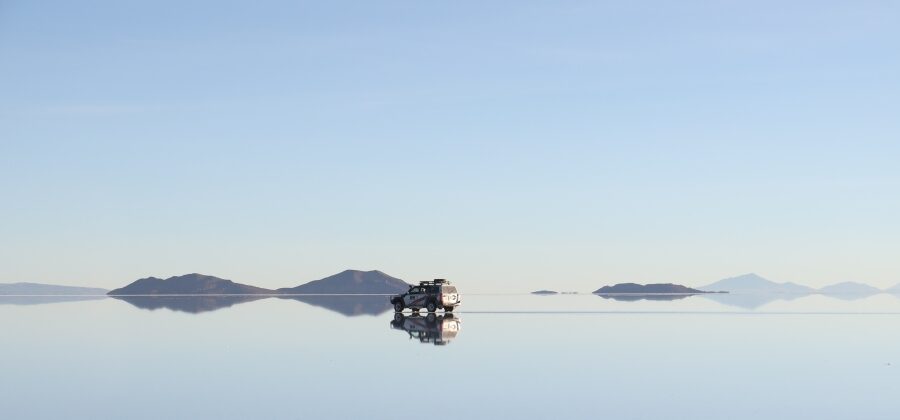
- Mirror Effect: If you’re visiting during rainy season (our tour happened at the end of March, and so we were lucky to enjoy both the mirror effect and visit the Incahuasi Island!), you get to experience the world-famous “mirror effect”. A thin layer of water covers the Salar, creating a perfect, blindingly beautiful reflection of the sky, clouds, and mountains. It is a surreal sight where you cannot tell the earth from the heavens, and it is arguably one of the most magical natural wonders on Earth! We’d recommend to pack flip flops, as your shoes will most likely get wet and full of salt.
- The Train Cemetery: Before finishing in the town of Uyuni, you’ll likely visit the Cementerio de Trenes, where old 19th-century steam trains sit rusting in the desert. Nothing special in our opinion, but one of the only attractions the town offers.
Our Adapted Experience
Cacti & Otherworldy Sights
As mentioned, our final itinerary turned out a little differently than planned. There was a risk of military presence on the Sunday we were supposed to experience the salt flats, which put our guide and the tour at risk. To ensure we didn’t miss out, we decided to change the plan.
Instead of visiting Salar de Uyuni on the morning of the third day, we ended our second day there. This meant that instead of the famous sunrise from Incahuasi Island, we witnessed a magical sunset combined with the mirror effect of the flats. The entire experience was otherworldly; we completely agree with those who call this one of the most unique and magical places on Earth. No matter how many photos we had seen, nothing could have prepared us for the moment our driver Gonzalo actually entered the desert. From one moment to the next, we found ourselves surrounded by a vast, bright nothingness. Any sense of direction was gone, and it was impossible to tell how fast the car was going because there were no points of perspective.

After a short drive, we arrived at Incahuasi Island. The island is covered in giant cacti and offers spectacular views over the white desert below. Our eyes had to work to adjust to the intense light and the ethereal views, and we simply couldn’t get enough of it. Seeing the 4x4s parked on the desert floor below, looking like tiny black specks in an otherwise endless white landscape, really put the scale of the place into perspective.
Perspective Photos & The Magic of the Mirror Effect
The next stop took us away from the island and into the heart of the desert for those iconic “perspective” photos. Once again, Gonzalo knew exactly what he was doing. He directed us on how to stand while he positioned props like a dinosaur toy and a wine bottle to create hilarious, mind-bending shots. We had a great time with the rest of the group, and Gonzalo was eager to help us implement our own creative ideas. We were so impressed by the effort he put in to make the trip unforgettable, despite the long, exhausting day (and short night) he’d had.

Then came our final, and perhaps favorite, stop. We drove until we reached a section of the desert that still held water from the rainy season, creating the famous mirror effect. Arriving here was another another absolutely magical moment. As the sun began to cast a soft evening light, the reflection was breathtakingly beautiful. The mountains mirrored perfectly in the water, and the entire scene felt incredibly peaceful and serene, despite a few other cars and visitors nearby.

We hadn’t brought flip-flops, so our shoes were quickly soaked and encrusted with salt, but we couldn’t have cared less. The Salar de Uyuni is one of those rare places that teleports you into the “here and now“, making you forget everything else. All your senses are captivated by the divine beauty of the landscape. As the sun dipped lower, the sky turned into insane shades of yellow, red, and deep purple. We simply stood there in awe. Gonzalo had promised us a spectacular experience despite missing the sunrise, and both he and the Salar de Uyuni absolutely delivered.
Arriving in Uyuni
What to Do in Uyuni
Instead of the typical afternoon arrival on Day 3, our “marathon” schedule meant we rolled into the town of Uyuni on the evening of Day 2. The town itself is primarily a gateway for the salt flat tours. Aside from the Train Cemetery we mentioned earlier, there isn’t much to see or do. On a “normal” tour, you would arrive late in the afternoon on Day 3, which gives you just enough time to grab dinner before catching one of the many night buses (usually leaving between 8:00 PM and 10:00 PM) to destinations like La Paz or Sucre. However, in our case, bus departures were completely uncertain due to the Election Day restrictions. To play it safe, we decided to stay one more night in town.
Where to Stay in Uyuni
Since we decided to stay an extra night in Uyuni, we booked a room at Cabañas Sal y Piedra. Funnily enough, this turned out to be another salt hotel, so we actually got to have the unique experience we thought we’d missed out on during Day 2!

The place was clean, comfortable, and offered private bathrooms and a kitchen. Breakfast was included in the price, though we were served eggs, cheese, and a fruit bowl with yogurt, which unfortunately left us with just bread and jam. To be fair, we only made the request for vegan food the night before; if you’re staying here, we recommend mentioning your vegan requirements at the time of your initial reservation to give them more time to prepare.
Vegan Food in Uyuni
Even though Uyuni is a remote desert town, it offers some surprisingly great options for vegans. One of the top-rated spots is the completely vegetarian Llama Café; we unfortunately couldn’t try it due to their opening hours, but it seems to have tons of great vegan options and a very welcoming vibe. For those looking for a more upscale or “fancy” experience after days in the desert, you can head to The Hot Spot Uyuni. They offer a dedicated vegan five-course menu that gets great reviews, and although we didn’t get to try this one either, we secretly wish we had come here to celebrate the end of our tour. And let’s not forget Minuteman Pizza, which is a classic traveler favorite that offers delicious pizzas which can easily be ordered without cheese.

Finally, we want to add Restaurante Sabromix to the list. We ended up eating here a total of three times (dinner, breakfast and lunch) during our unexpected early stay in Uyuni with the rest of our group. While we don’t know what their normal daily menu looks like, they went above and beyond to provide amazing vegan meals for us during our visits.
What We Ate: Vegan Food on the Salt Flats Tour
Breakfast on the Tour
Vegan breakfast options on the Atacama too Uyuni tour were simple, but satisfying: on the first morning while waiting at the border, we were served bread with avocado, while the second morning usually consisted of bread with jam and fresh fruits. Because of our unplanned stay in Uyuni on the third morning, we ended up having breakfast at a restaurant called Sabromix, where they incredibly provided vegan pancakes for us.
Lunch and Dinner on the Tour
When it came to lunches and dinners, the vegan options mostly revolved around potatoes, fresh vegetables, and french fries. A major highlight of the trip was definitely the hearty potato casserole with soy meat on our second day, which showed a lot of effort from the tour. For our dinner on the second day, as well as breakfast and lunch on our third day in Uyuni, we returned to Restaurante Sabromix. They consistently exceeded our expectations with their amazing vegan options: beyond the pancakes, we enjoyed a delicious quinoa with grilled vegetables and a flavorful mushroom stir-fry for our final lunch. We aren’t entirely sure if this restaurant is a standard stop on the usual tour, but it was a fantastic find.

Snacks for the Tour
Despite our positive experience, we would always encourage vegan travelers to pack some emergency snacks as well. San Pedro de Atacama is a great option to stock up for the coming trip through the desert. We had some protein bars from the supermarket in San Pedro and even brought along some bread and peanut butter just in case the tour meals weren’t quite filling enough.

Essential Packing List for the Bolivian Salt Flats
Documents & Cash: Don’t forget your passport and your PDI tourist card to exit Chile. You will also need roughly 250-300 Bolivianos per person in cash for the Eduardo Avaroa Reserve entrance fee, the Termas de Polques hot springs (30 Bs / approx. 4.35$ / 3.75€), and public toilets along the way.
Clothing: The Altiplano is a land of extremes. Pack layers, a warm jacket, a beanie, and gloves for the freezing nights and early mornings. Conversely, the high-altitude sun is incredibly strong, so bring a hat, sunglasses and high-SPF sunscreen.
Snacks & Hydration: While our tour was great, we always like to bring some vegan snacks just in case. Stock up in San Pedro de Atacama on protein bars, nuts, peanut butter, and at least 3 liters of water per person. Coca leaves, coca tea or coca candy are also useful for the altitude!
The “Mirror” Gear: If you are visiting during the rainy season, bring a pair of flip-flops or waterproof sandals for the salt flats. The salt water is very corrosive, so remember to rinse your footwear with fresh water as soon as you reach your final destination.
Final Thoughts
Let us start by saying that the Salar de Uyuni was one of the most incredible places we have ever seen, and without a doubt a highlight of our entire trip through South America. It truly feels like being catapulted into another world. No photo can fully capture what it’s like to stand there and witness it with your own eyes for the very first time. If you have the opportunity, we cannot recommend it enough.
When it comes to vegan food on the tour, we were initially a little concerned about how seriously our request would be taken. We had adjusted our expectations, knowing this experience wasn’t really about the food, but after completing the tour, we can honestly say the options provided exceeded what we had hoped for. We ate well, stayed full, and felt that a real effort had been made to accommodate us.
Regarding the change of plans due to the election, we believe it ultimately comes down to how you respond to unexpected situations. In hindsight, the tour company could likely have anticipated things better, especially since election dates are known in advance. That said, it didn’t take away from our experience at all. We still had an incredible time and never felt like we missed out on anything. A huge part of that was thanks to our driver and guide Gonzalo, who went above and beyond to make the trip special. He even sacrificed his own sleep to ensure we could see everything before the roads closed. His dedication truly made the experience unforgettable.

Of course, our vegan experience on this Atacama to Uyuni tour remains subjective. Before the trip, we tried to find insights from other vegan travelers, but mostly came across scattered comments in forums and on social media. While there’s no guarantee every tour will offer the same level of catering, we do feel that veganism is becoming increasingly understood in both Chile and Bolivia. Many plant-based staples are already part of the local cuisine, making it far easier to navigate than you might expect.
Have you done the Atacama to Uyuni route, the reverse trip, or even a day tour? Let us know in the comments! We’d love to hear about your experience.

This guide is completely free. If it helped you plan your trip and you’d like to say thank you, you can do so here 🙂

FAQ: Vegan Travel & Planning for the Atacama to Uyuni Tour
Is the Atacama to Uyuni tour vegan-friendly?
Yes! While the region is remote, most agencies are accustomed to dietary requirements. You can expect hearty meals like potato and soy meat casseroles, fresh avocado, pasta, and plenty of local quinoa. Communication is key—always confirm your needs when booking and remind your driver on day one.
Which tour agency is best for vegans?
We had a great experience with White & Green Travels. They provided a variety of plant-based meals including a soy meat dish that was a real highlight. Other popular agencies like Cordillera Traveller also have positive reviews for catering to vegetarians and vegans.
Do I need to bring my own vegan snacks?
Absolutely. While the main meals are filling, the drives are long. We recommend stocking up in San Pedro de Atacama on protein bars, nuts, peanut butter, and fruit. It’s better to have extra food than to be hungry at 4,000 meters!
How much cash (Bolivianos) should I bring?
You should bring approximately 250–300 Bolivianos per person. This covers the Eduardo Avaroa Reserve entrance fee (186 Bs), the Incahuasi Island fee (30 Bs), hot springs (30 Bs), and small change for public toilets (usually 5–10 Bs).
What is the “Mirror Effect” and when can I see it?
The mirror effect occurs when a thin layer of water covers the salt flats, creating a perfect reflection of the sky. This typically happens during the rainy season, from December to March. However, be aware that excessive water can make some areas, like Incahuasi Island, inaccessible.
Is the PDI card important for the border crossing?
Yes! The PDI tourist card is the small white slip you received when entering Chile. You MUST hand this over to Chilean immigration to exit the country. If you lost it, visit the PDI office in San Pedro de Atacama before your tour starts to get a replacement.
Can I drink the tap water on the tour?
No. Tap water in the remote Altiplano and Uyuni is not safe for drinking. Most tours require you to bring your own water supply (at least 5–6 liters per person for the three days). Bottled water is also available for purchase in some small villages along the way.
How do I handle the high altitude?
The tour reaches altitudes of nearly 5,000 meters. We recommend spending at least 2–3 days in San Pedro de Atacama to acclimatize first. During the tour, drink plenty of water, eat light, and try the local coca tea (mate de coca), which is a traditional remedy for altitude sickness.

About the Authors
Lynn & Daniel are the vegan couple behind VanderlustJourney, combining their passion for adventure and plant-based living. They share stories and visuals of natural places, hikes, vegan discoveries, and meaningful encounters from around the world – always striving to travel with kindness.
👉 Follow us on Instagram
✉️ Contact: vanderlustjourney@outlook.com
Further Reading
Blog Articles
Chile:
- Day Hikes in Torres del Paine: Stunning Trails for Every Skill Level
- Best Hikes in Chile: From Patagonia to Atacama
- Vegan in Torres del Paine
- The Carretera Austral By Bus: A Journey of Expectations, Challenges & Growth
Vegan Guides:
- Vegan Travel Guides
- Why Vegan? The Reason We Travel the World Plant-Based
- Vegan Travel – Exploring the World Without Compromising Your Values
Thanks for sharing, looks an amazing adventure and great place to visit 🙂