
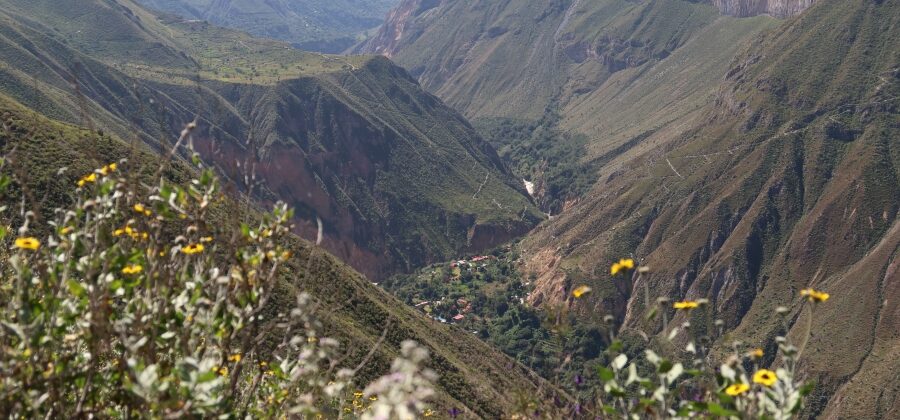
Can you actually find great vegan food at 3,400 meters in a remote Peruvian canyon? The Colca Canyon, one of the deepest canyons in the world, is famous for its stunning landscapes, sun-exposed trails, and gorgeous oasis villages. Along the trekking routes, small villages welcome hikers with simple accommodations in a beautiful setting, refreshing drinks, and sometimes even a pool! Of course, we wondered how easy it would be to find vegan food in such a remote setting. In this article, we’ll share our personal experience being vegan in the Colca Canyon, including our itinerary, accommodation tips, and everything you need to plan your own adventure.
Introduction to the Colca Canyon
- Best for: Giant Andean Condors, high-altitude trekking, pre-Inca terraced landscapes, and natural volcanic hot springs
- Route: Arequipa → Cabanaconde → Canyon Floor (Llahuar/San Juan/Sangalle)
- Getting around: Colectivos and buses between villages; strictly by foot once descending into the canyon
- When to visit: May-Sept (Dry season, clear trails, very cold nights); Oct-Apr (Green season, lush scenery, rain showers)
- Fees & Cash: Required Boleto Turístico (entrance fee) is S/ 70. Canyon lodges are often cash-only
- Connectivity: Decent 4G in Cabanaconde; often no signal at the canyon floor. Some lodges offer Wi-Fi
A rugged descent into one of the world’s deepest canyons, transitioning from high Andean plains to a tropical microclimate at the base.
This post contains affiliate links. If you make a purchase or booking through these links, we earn a small commission at no extra cost to you. This supports our work and allows us to keep offering free content here on the blog.
Why is the Colca Canyon Famous?
The Colca Canyon, close to Arequipa, is known as one of the deepest canyons in the world (while this is up for debate, it’s definitely twice as deep as the Grand Canyon) and one of Peru’s most beautiful hiking destinations (not up for debate). During our visit in April, at the end of the rainy season, the canyon was surprisingly green and full of life: flowers, butterflies, black bumblebees, and the sound of birds were everywhere. These sights and sounds accompany the breathtaking views, with cacti completing the “Peru-style” scenery, while the mighty Colca River flows deep below.

Breathtaking is used here in more ways than one: a curious fact about one of the “world’s deepest canyons” is that it is, like Lake Titicaca, still located at a very high altitude. While the villages on the canyon floor sit at around 2,000 meters, Cabanaconde (the towns where most hikers begin) lies at 3,287 meters above sea level, high enough for altitude sickness to be a very real factor for some.
Hiking the Colca Canyon
Hiking the Colca Canyon was one of our highlights of our Peru trip! Aside from an overnight hike in Albania, it was our first multi-day trek and came with many beautiful moments, heartwarming encounters with locals, and some challenges (let’s talk heat and steep descents). We were especially surprised by how green and full of life the canyon was. Colorful flowers lined the trails, insects buzzed around us, and the landscapes constantly changed as we descended deeper into the canyon. The accommodations were absolutely stunning, often surrounded by green trees with flowers and fruits, a pool, and with animals (like dogs, cats, and chickens) running around freely. And we can already reveal that we ate very well as vegans… but more on that below 🙂

This said, the Colca Canyon hike is definitely not an easy trek. While there are several itineraries, all of them descend into the canyon on the first day and go up again on the last – meaning you’ll climb more than 1,000 meters in elevation. As casual, moderately fit hikers (we mostly hike while traveling and like to take it slow and stop for pictures after every turn), we found the trek moderately to highly challenging. There are some strategies that can make it easier, such as packing light (note to self) and starting early on the last day to avoid the heat on the ascent. It’s also highly recommended to acclimatize for a few days in Arequipa (or another high-altitude destination) before tackling the Canyon.
Itinerary
Picking the Best Itinerary
There are multiple routes to explore the Colca Canyon, and there is no single answer to which one is the best. The ideal itinerary depends on your available time, fitness level, and personal interests. Generally, it helps to choose your route based on two main criteria:
- How much time? Most people hike the Colca Canyon in either one or two nights. We decided on two nights to keep each day’s hiking shorter and more manageable… and of course, to allow more time to relax by the pools at our accommodations 😉
- How much distance? There are a few key villages in the canyon that offer accommodations for hikers to stop for a meal or spend the night: Llahuar, Sangalle, and San Juan de Chuccho. Most trekking routes are built around these locations. We chose the route Cabanaconde – Llahuar – Sangalle – Cabanaconde, which we’ll present in more detail below. This itinerary covers approximately 27 km and offers a great mix of scenery, relaxation, and manageable hiking distances. For a detailed overview of all available routes, we recommend checking out this informative article from Along Dusty Roads.
Our Itinerary in the Colca Canyon
Among the many trail options, we personally chose the route Cabanaconde – Llahuar – Sangalle – Cabanaconde in a timeframe of 3 days/2 nights.
This essentially meant that the first day was entirely downhill, followed by a moderate up-and-downhill route on the second day, and the notorious but unavoidable climb back up on the third day.
Day 1: Cabanaconde – Llahuar
Most articles about this route warn you about the infamous final ascent, and for good reason: you’ll climb around 1,000 meters in less than 5 km. However, we’re going to go against the general consensus here. While the last day is definitely tough, we found it manageable. What really got us (or rather, Lynn) was the descent on the first day. While for most people, the constant downhill route might be painful on the knees, for Lynn it was painful for the mind. Prone to vertigo (sometimes in the weirdest situations), she actually faced three of her nemeses that day: steep descents, an overpacked backpack, and intense heat. So we took it slow. Along the way, we were overtaken by countless hikers, a kid and his grandma, and even a snail. But we arrived (without a twisted ankle)!
But let us not sound too negative either: despite its mental challenges for uncoordinated people (aka half of VanderlustJourney), the trail was absolutely stunning. From our very first steps into the Colca Canyon, it became clear why this is considered one of the most beautiful places in Peru. Flowers bloom in shades of yellow, red, and purple, butterflies swirl around, and birds sing along the trail. With a bit of luck, you might even spot a condor soaring above the canyon walls.

The steepness is also very manageable for the average hiker (of all the people we met, nobody complained about it; and we didn’t see it in online comments either, the ultimate tool for all respectable complainers). While there are a few loose gravel sections here and there, the trail is generally not too technical.
On that first day, we continued down to Llahuar, which involves another 100 meters of descent; and of course, the same amount of climbing back up the next day. Llahuar itself is small and remote, consisting mainly of two lodges tucked into a beautiful setting deep inside the canyon, right next to the powerful river rushing by. We stayed at Casa de Virginia, and while you find more details under “Accommodation and Vegan Food in the Colca Canyon“, let us just say how amaziiiing it was to relax in a warm thermal pool for the rest of the afternoon.

Day 2: Llahuar – Sangalle
Before the hike, our minds were mostly focused on Days 1 and 3. Day 2 was spent deep in the canyon, trekking between two villages – how hard could it be? It was only after we completed the first day’s descent that we actually looked a bit closer at the map and realized there was still a fair amount of climbing involved: over 600 meters of elevation gain, to be exact.
We decided to leave our lodge early to escape the heat of the day (and get more time at the next pool, hehe) and managed to complete this section in about five hours at a leisurely pace. After the initial ascent, the trail is almost flat for a long stretch before descending again into the oasis of Sangalle. While large parts of the route were in the shade of the canyon (at least during our visit in April), we would still recommend starting early: the morning light casting its soft glow on the mountains and canyon was simply too beautiful to miss.

The hike concludes by crossing a bridge over the impressive Colca River before one last mini ascent to enter Sangalle. We had a bit of trouble finding our lodge at first, but with the help of some friendly locals, we eventually made it! In a slightly masochistic fashion, you can already see the route up for Day 3 while hiking into Sangalle, making you very aware of the steep climb that awaits. But alas, that was a problem for future Lynn and Daniel. Today was another pool day!

Day 3: Sangalle – Cabanaconde
Day 3 arrived, and with it the moment of truth: would we make it up, or would we live in the canyon for the rest of our lives? (Some people opt for a mule ride, but for obvious reasons, this was out of question for us.) Our fantastic host, Ronaldo, offered to prepare breakfast at the unholy hour of 4:30 am and we accepted happily, eager to start early and escape the heat once again. We finally began the climb at the break of dawn, shortly before 6 am (if you eat everything Ronaldo serves, be prepared for a bit of digestion time!).

Hiking up was more or less as expected: it was steep and steadily going up, with a few flatter (we didn’t say flat) sections to allow you to catch your breath. We walked at a slow but steady pace, and could slowly but surely see the valley shrink beneath us: a very satisfying feeling. To Lynn’s delight, it was an overcast morning, so sun exposure wasn’t really an issue, even though we were still sweating enough from the effort. About three times, we stepped aside to let groups of tourists on mules pass, but otherwise, the trail was far less busy than we had expected. We stopped from time to time to admire the view to catch our breath and give our legs a break, and finally, after about three hours, we reached the top!
Once you arrive, you’re welcomed with a round of applause from local vendors and fellow hikers who made it up before you. There are drinks, snacks, and even a toilet waiting. Aaand you can finally admire the view knowing you don’t need to take another step uphill (prayers that you didn’t forget anything at your accommodation in the valley).
Well, to be entirely honest, there is still about a 1-kilometer walk left to the town of Cabanaconde. And while this path is nothing compared to what you’ve just accomplished, it still makes itself known in your legs. But no hurry – you’ve just hiked up a freaking 1,000 meters in elevation! Take your time, enjoy the view, and know that for the rest of the day, you can either relax in your Cabanaconde accommodation or on the bus back to Arequipa.

Accommodations and Vegan Food in the Colca Canyon
Overview of Accommodations
| Accommodation | Location | Price (Est.) | Vegan Highlights | Key Features |
|---|---|---|---|---|
| La Terraza de Huaruro | Cabanaconde | around €20 | Simple (Bread/Jam) | Right next to the bus stop; perfect for early departures. |
| Homestay Pachamama | Cabanaconde | €60 | Vegan Pizza & Breakfast | Expert trekking advice; highly rated “basecamp” atmosphere. |
| Casa de Virginia | Llahuar | €15 – €30 | Good veganized meals | Thermal pools; incredible river views; quieter vibe. |
| Llahuar Lodge | Llahuar | €20 – €35 | Vegan options available | Natural hot pools right by the river; very popular with hikers. |
| Sangalle Cielo Lodge | Sangalle (Oasis) | €35 | Vegan Pancakes, attentive host | 4:30 AM breakfast; Amazing host (Ronaldo); large pool. |
| Tropical Lodge | Sangalle (Oasis) | €18 – €25 | Good vegan range | Budget-friendly; 6:00 AM breakfast; nice pool and staff. |
| Posada Gloria | SJ de Chuccho | €10 – €30 | Big portions, accommodating for vegan food | Welcoming family atmosphere. |
Cabanaconde
We arrived in Cabanaconde by bus from Arequipa and spent one night here before starting the hike the next morning. We stayed at La Terraza de Huaruro (21€/night), which offered simple rooms and friendly service. As we had prepared our own sandwiches for our morning hike, we didn’t try the breakfast offered at the hotel. The accommodation is located just a few meters away from where the bus arrives and departs (but so is almost everything in this small town!) and is a convenient spot to start the hike into the Colca Canyon. Also, you can leave your luggage here while completing the trek, which is super useful!

Another accommodation in Cabanaconde with excellent reviews is Homestay Pachamama (around 60€/night). While we didn’t stay here ourselves, we tried their restaurant and had a tasty vegan pizza. Reviews also mention good vegan options for breakfast. We met a couple of hikers on the trek who stayed here and loved it; apparently, the owners are also known for giving excellent tips to help you prepare for the Colca Canyon trek.
Llahuar
Casa de Virginia
Llahuar is a small place deep in the Colca Canyon that consists of two lodges. We stayed at Casa de Virginia (around 16€/night) and can wholeheartedly recommend this place. The rooms are basic, but clean, and so are the shared bathrooms. The entire place is basically a lovely garden, full of green, flowers, and fruits everywhere. The highlight after a morning of hiking were definitely the thermal pools (3 small pools with different temperatures), which is perfect for relaxing in the afternoon. Plus you have 2 lovely dogs, one cat (as far as we could see) and a group of animated chickens roaming the property. There are multiple cosy outside corners to relax and with a view on the river below.

Vegan Food at Casa de Virginia
We asked ahead of time if vegan meals were possible, and the staff were very accommodating. On the day we arrived, we had an avocado and tomato sandwich for lunch. Dinner was a warming noodle soup followed by a plate of rice and vegetables. For breakfast the next morning (served starting at 6:30 am), we had bread and jam; depending on availability, the host also serves avocado. All in all, the meals were simple (which is to be expected in such a remote location), but they were tasty and satisfying.

Llahuar Lodge
Llahuar Lodge (20-35€/night depending on the room) was the first accommodation in Llahuar and is still widely popular with trekkers. They have natural hot pools right by the riverside, and reviews describe the rooms as comfortable and clean.
Vegan Food at Llahuar Lodge
While we didn’t stay here ourselves, reviews mention that vegan food can be accommodated; however, some visitors note that portions (for vegans and non-vegans alike) can be rather small.
Sangalle
Sangalle Cielo Lodge
Sangalle Cielo Lodge (around 35€/night) was one of our favorite stays in Peru! The owner, Ronaldo, is a lovely person who welcomed us with a big smile and was very attentive to all our needs. You get a welcome drink right upon arrival and a free bottle of water, which adds a thoughtful touch to the stay. And then, there is the pool! Large and clean, it was the perfect refreshment after the hike. The whole property is green, well-maintained, and offers cosy spaces to relax. There is also a sweet dog running around and the occasional group of mules passing by.

Vegan Food at Sangalle Cielo Lodge
Ronaldo truly went the extra mile to accommodate our vegan requests. For dinner, we had a choice of several soups, pasta, and rice dishes. We eventually settled on a quinoa soup and spaghetti with veggies and avocado; the portions were generous and very filling. But the real highlight was the breakfast! It is served as early as 4:30 am for those wanting an early start on the hike up to Cabanaconde (a major plus, as not every lodge in Sangalle offers this). Ronaldo was even thoughtful enough to know that the local bread contained milk, so instead, he made us homemade vegan pancakes with fruit, along with a large plate of avocado, tomatoes, and cucumber. It was the absolute perfect fuel for the climb ahead. We really want to highlight this experience – heading into the Colca Canyon, we expected the remoteness to mean eating quite simply for those three days, but Ronaldo completely exceeded our expectations!

Tropical Lodge
We didn’t stay at Tropical Lodge, but we met some hikers on the trail who did and were satisfied with their experience. It’s a slightly more budget-friendly option (around 18-25€/night), and reviews frequently highlight the pool and the friendly staff.
Vegan Food at Tropical Lodge
Although we didn’t end up staying at Tropical Lodge, they responded to our inquiry about vegan food by confirming they can provide vegan breakfast, lunch, and dinner options. Reviews from other plant-based travelers confirmed this as well. One helpful tip we picked up from hikers we met: they only start serving breakfast at 6:00 am, which is worth noting if you are planning a very early start for your final climb.
San Juan de Chuccho
Posada Gloria
While San Juan de Chuccho didn’t make it on our final itinerary through the Colca Canyon, we looked briefly at Posada Gloria (10-30€/night depending on room type), which has excellent reviews online. People highlight the welcoming atmosphere, the clean rooms, and the beautiful location.
Vegan Food at Posada Gloria
While we didn’t stay here, the reviews of the vegan options almost made us wish we had! Online comments from visitors suggest that plant-based requests are well accommodated and that the portions are both generous and tasty.
Tips for Vegan Trekkers
How to Find Accommodations
In general, we like to book accommodations with a kitchen so we can whip up our own plant-based meals. However, deep in the Colca Canyon, you are essentially at the mercy of the lodge kitchens, so that simply isn’t an option. In this case, we ask directly while booking if the hotel or lodge can provide vegan options.
For this, we like to be very specific: instead of just asking for “vegan” food, we explain exactly what we mean, specifying that we don’t eat meat, fish, milk, cheese, or eggs. In Spanish, your message can look like this:
“Somos veganos. No comemos nada de origen animal: ni carne, ni pollo, ni pescado, ni huevos, ni lácteos (mantequilla, queso, o leche).” (We are vegan. We don’t eat anything of animal origin: no meat, chicken, fish, eggs, or dairy—butter, cheese, or milk.)

We also highly recommend looking through reviews before booking. By using the search bar within the reviews on Google or TripAdvisor and typing “vegan”, you can often find the experiences of other travelers to see if they were well-fed. If they were, that’s a huge green light to book! This is exactly why we always encourage you to leave your own reviews after a positive experience: it truly is the best way to help the vegan travel community grow.
Bring Snacks
Even though we’ve had surprisingly positive experiences with vegan food in remote corners of South America (like in the Uyuni Salt Flats, Torres del Paine or El Chaltén), we never start a multi-day trek without a “safety net”. Our packing list always contains some bread and a jar of peanut butter (because it’s so easy to find everywhere),nuts or seeds, and protein bars. If you traveling to Colca Canyon from Arequipa, we found vegan protein bars at PlazaVea (bigger surpermarket) and Nutriorganik (organic store).
Packing List for Colca Canyon

With our “overpacking” confession at the beginning of this article, we’re not sure why anyone would want a packing list from us… but we can honestly say we’ve learned from our mistakes! We promise to only include the essentials we actually found useful.
| Item | Notes & Why You Need It |
|---|---|
| Water (min. 2L) | You can buy refills at the lodges each night to keep your pack light. Note that water is more expensive in the canyon compared to Arequipa, but we found this understandable due to the remoteness of the place. |
| Hiking Shoes | Ideally broken-in boots with good grip for the loose gravel sections. |
| Hiking Poles | A massive help for saving your knees on the descent and finding a rhythm on the 1,000m climb. |
| Hiking Trousers / Shorts | Depending on your preference, long pants for the cold evenings. |
| T-shirt | Moisture-wicking materials are best for the midday heat. |
| Warm Jacket / Sweatshirt | As soon as the sun goes down, the canyon temperature drops significantly. |
| Rain Jacket & Pants | Absolutely essential if you are trekking during the rainy season. |
| Swimwear | For the amazing thermal pools! |
| Flip-flops | Not essential, but a massive relief for your feet after 5+ hours in boots. |
| Sunglasses & Hat | The high-altitude sun is brutal. A cap or wide-brimmed hat is a lifesaver. |
| Sunscreen | High SPF and reapply often! |
| Mosquito Spray | Essential for Sangalle (the Oasis), where small sandflies can be quite persistent. |
| Toilet Paper | Some lodges aren’t always fully stocked; better safe than sorry! |
| First Aid Kit | Blister pads (Compeed), basic meds, and band-aids. |
| Vegan Protein Bars | Some fuel for the way 🙂 |
| Electrolytes | Helpful for recovery if you’re sweating a lot in the intense canyon heat. |
| Power Bank | Electricity in the canyon is unreliable; don’t count on being able to charge. |
| Cash (Soles) | Crucial! Bring enough for rooms, food, water, and the park entrance fee. |
Toilet paper, towels and soap: Our lodges provided these, so we didn’t need our own; but double-check with yours!
How to Get to the Colca Canyon
To start your trek, you first need to get from Arequipa to Cabanaconde. It’s a long, winding, but incredibly scenic journey that takes about 6 hours and crosses a high-altitude pass at nearly 5,000 meters.
We booked our bus from Arequipa to Cabanaconde and back online in advance. Some crazy people like to take the early morning bus (3am or 4am) to start the hike on the same day, but we preferred the laid-back version: taking an afternoon bus, arriving in the evening and starting in the morning after spending a night in Cabanaconde.
For those who don’t want to go back to Arequipa but are traveling on to Cusco, we saw that Pachamama Hostel was offering transfers on certain days of the week. If this is interesting for you, it’s best to contact them directly for more info.
Best Time to Visit the Colca Canyon
The Colca Canyon has two distinct seasons: Dry and Rainy.
The Dry Season (May – October)
- The Pros: You are almost guaranteed clear blue skies and sunshine, which is perfect for spotting condors. The trails are dry and stable.
- The Cons: It is the high season, so the main trails and the “Oasis” in Sangalle can get a bit crowded. Also, the nights get extremely cold, sometimes dropping below freezing.
The Shoulder Season (April & November)
We visited in early April and loved it! Since the rainy season had just ended, the canyon was incredibly green and full of blooming flowers. The weather was starting to stabilize, so we had plenty of sun, but there were far fewer tourists on the trail than in June or July. From what we observed, the mornings had a clear-blue sky and clouds started to form around late morning/mid-day. We only experienced a few stray raindrops on our first afternoon and saw some far-away thunderstorms on the second evening.

The Rainy Season (December – March)
- The Pros: The canyon is at its most beautiful and vibrant green. You’ll have most of the trail to yourself.
- The Cons: Heavy rain can make the steep trails muddy and treacherous. Landslides occasionally close the roads from Arequipa, and clouds can often block the view at the Condor’s Cross.
Conclusion: Trekking the Colca Canyon as Vegans
So, back to the question we asked ourselves before starting this trip: is it worth it? And how easy will it be to find vegan food? In retrospect, we can say that we had an amazing time! In early April, the Colca Canyon is lush and colorful, the mighty river is full of water, and you’ll have the trails mostly to yourself. Our vegan requests were accommodated amazingly well. Despite the remote location, our hosts managed to create nourishing, tasty meals – in fact, we didn’t even touch all the snacks we brought “just in case!”.
We recommend contacting your accommodations in advance to inform them of your vegan dietary requirements, and then you’re ready for your own Colca Canyon adventure!

This guide is completely free. If it helped you plan your trip and you’d like to say thank you, you can do so here 🙂

FAQ: Vegan Travel & Planning for the Colca Canyon
Is the Colca Canyon trek vegan-friendly?
Surprisingly, yes! While the canyon is remote, most lodges are very accommodating if you communicate early. You can expect hearty meals like quinoa soup, pasta with avocado, and lentil stews. The key is to be specific—use our Spanish survival script to ensure your hosts understand “no dairy or eggs.”
Which lodge is best for vegans?
Our top pick is Sangalle Cielo Lodge. The owner, Ronaldo, is incredibly knowledgeable and even prepared homemade vegan pancakes for us at 4:30 AM to fuel our climb. Casa de Virginia in Llahuar is another great choice for its flexible kitchen and thermal pools.
Do I need to bring my own vegan snacks?
Yes. While meals are filling, “vegan protein” isn’t a staple in the small canyon tiendas. We recommend stocking up in Arequipa (at Nutriorganik or PlazaVea) on peanut butter, bread, and protein bars. It’s the perfect “safety net” for long hiking days.
How much cash (Soles) should I bring?
Bring enough to cover your accommodations (avg. S/ 80–140 per night), the Boleto Turístico (S/ 70), and extra for water and snacks. Most canyon lodges are cash-only, and there are no ATMs once you leave Chivay or Cabanaconde.
Can I drink the water in the canyon?
No. Tap water is not safe to drink. You can buy large bottles of water at every lodge, but be prepared for higher prices (S/ 10–15) due to the remoteness. Alternatively, bring a water filtration bottle or purification tablets to save money and reduce plastic waste.
Should I take a mule to get out of the canyon?
While many tourists use mules for the final 1,000m ascent, we chose to hike up. As vegans, we prefer not to use animals for transport, especially on such punishing terrain. Starting at dawn (around 5:00 AM) makes the climb much more manageable by avoiding the intense sun.
When is the best time for a “green” canyon experience?
If you want to see the canyon lush and full of flowers like we did, visit in April. This “shoulder season” offers the perfect balance of manageable weather, fewer crowds, and stunning green landscapes just after the rainy season ends.
How do I get to Cusco from the Colca Canyon?
You don’t have to go back to Arequipa! You can book a direct transfer from Cabanaconde to Cusco. Pachamama Hostel is a great place to arrange this; they offer vans on specific days of the week that save you an entire day of backtracking.

About the Authors
Lynn & Daniel are the vegan couple behind VanderlustJourney, combining their passion for adventure and plant-based living. They share stories and visuals of natural places, hikes, vegan discoveries, and meaningful encounters from around the world – always striving to travel with kindness.
👉 Follow us on Instagram
✉️ Contact: vanderlustjourney@outlook.com
Further Reading
Blog Articles
South America Adventures:
- Day Hikes in Torres del Paine: Stunning Trails for Every Skill Level
- Best Hikes in Chile: From Patagonia to Atacama
- Vegan Atacama to Uyuni Tour: What It’s Really Like
Vegan Guides:
Thanks for sharing, an interesting take on visiting The Colca Canyon, even though I’m not vegan, the hike around the canyon sounds lovely 🙂