
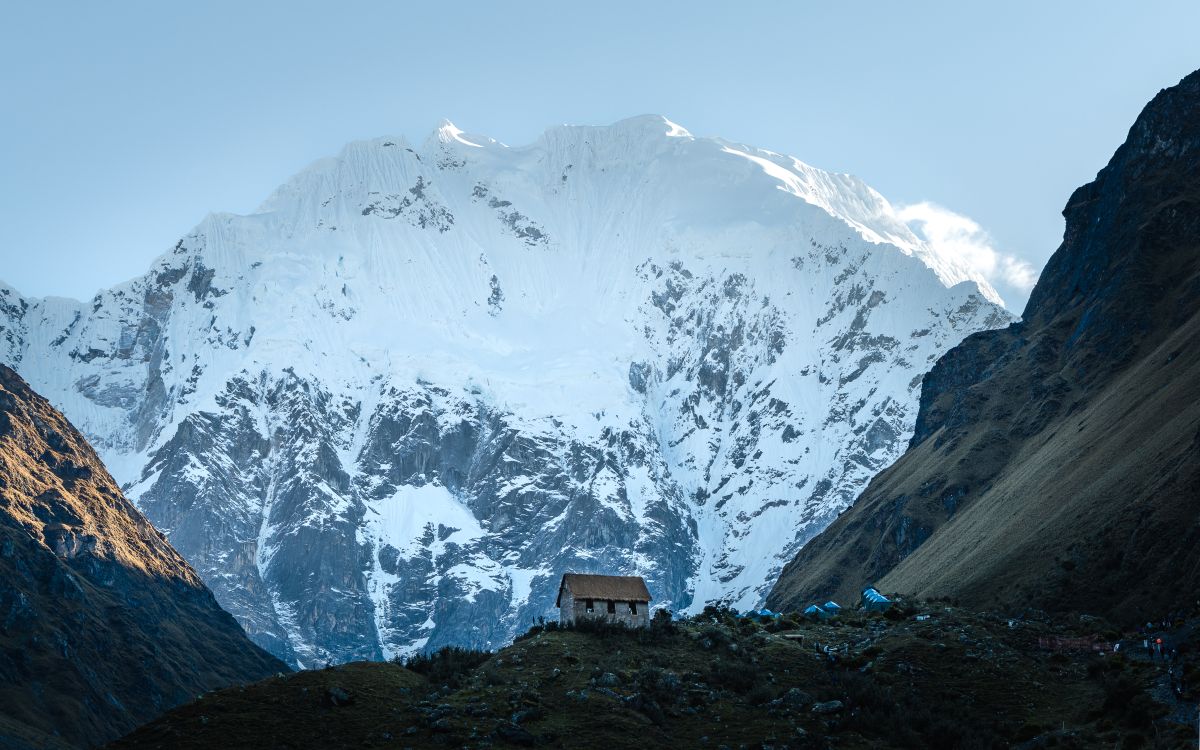
All roads lead to Machu Picchu: while you can choose to visit Peru’s most iconic landmark by public transport or with a guide, many people opt for a more adventurous way of hiking there. We embarked on the Salkantay Trek, a lesser-known alternative to the famous Inca Trail, which led us through different landscapes, climate zones, and altitudes. Traveling with us, as always, was the question: How easy is it to be vegan on the Salkantay Trek? In this guide, you will find our route, accommodations, vegan food on the way, and everything you need to know for your own adventure on the Salkantay Trek.
Introduction to the Salkantay Trek
- Distance: About 60 to 74 kilometers (37 to 46 miles), typically covered over 4 to 5 days
- Altitude: Max elevation of 4,630m (15,190 ft) at the Salkantay Pass
- Best for: Glacial peaks, the turquoise Humantay Lake, high-altitude hikes, and diverse cloud forest ecosystems
- Route: Cusco → Mollepata → Salkantay Pass → Collpapampa → Lucmabamba → Aguas Calientes
- When to visit: May–Sept (Dry season, clear skies, freezing nights), shoulder season in April and October
- Fees & Cash: No special Salkantay Trek permit is required, but bring cash for local fees, food, drinks and accommodation. Machu Picchu requires a separate entrance ticket.
- Connectivity: Mostly limited signal; some campsites offer paid satellite Wi-Fi
A great alternative to the Inca Trail that takes you from the Salkantay Pass down into the high jungle.
This post contains affiliate links. If you make a purchase or booking through these links, we earn a small commission at no extra cost to you. This supports our work and allows us to keep offering free content here on the blog.
About the Salkantay Trek
Machu Picchu and the Inca Trail are iconic for most travelers visiting Peru. However, the Salkantay Trek is a fantastic alternative, especially for those seeking a more independent and spontaneous hiking experience. Spanning approximately 74 km (46 miles), the trail takes you over 4-5 days to altitudes of up to 4,630 m (15,190 ft), leading through diverse climate zones all the way to Aguas Calientes, the gateway to Machu Picchu. From there, you can reach the famous Incan citadel either by bus or on foot.

We completed this trek independently (without a guide) and absolutely loved every minute of it. It was a true highlight of our travels through Peru and easily ranks among the best hikes we’ve ever done – and we’ve explored quite a few across South America, including some of our favorite routes in Chile.
As vegans, we were initially worried about having to carry large amounts of food, but those concerns quickly disappeared. Every accommodation we stayed at catered to our vegan requests, and we never went hungry. Below, we’ll share our detailed itinerary, the places we stayed, and what to keep in mind when exploring the Salkantay trek as a vegan.
Inca Trail vs. Salkantay Trek
| Feature | Inca Trail | Salkantay Trek |
|---|---|---|
| Main Focus | Incan ruins & history | Glaciers & landscapes |
| Distance | 43 km (26 miles) | 74 km (46 miles) |
| Max Altitude | 4,215m (13,828 ft) | 4,630m (15,190 ft) |
| Permits | Mandatory, advance booking strongly recommended | No permits needed |
| Independence | Guided tours only | Can be done independently |
| Arrival Path | Direct to Sun Gate | Via Aguas Calientes town |
| Difficulty | Moderate | Challenging / High-altitude |
To sum it up, the Inca Trail is more of a cultural adventure focused on ruins and ancient history, while the Salkantay Trek is a bit more off the beaten track and especially rewarding for its breathtaking natural landscapes. Because the Inca Trail can only be completed with a guided tour, its popularity means you must book your spot well in advance. The Salkantay Trek, however, can be tackled either independently or with a guide, and it offers the freedom of not needing to book months ahead. Ultimately, these were the main reasons we opted for the Salkantay Trek over the Inca Trail:
- The Inca trail can only be done through a guided tour, and all tours seem to work with porters to carry camping equipment and set up camp. We weren’t entirely comfortable with the idea of someone else having to carry our bags.
- We didn’t want to do it with a guide. Given that we already had some experience hiking and traveling in South America, we felt confident to be able to do the trail to Machu Picchu on our own and adding some flexibility and independence.
- We wanted to save money 🙂
- We were amazed by the landscapes pictures we saw from the Salkantay Trail and were more excited to discover those natural wonders than the cultural aspect of the area.
Can You Hike the Salkantay Trek Independently?
Yes! We completed the Salkantay Trek independently, without a guide or organised tour, and it worked really well for us.
One of the advantages of hiking independently is that you can organize the trek around your own pace and preferences. Instead of booking an all-inclusive tour, you can arrange your accommodation, transport and meals separately and decide where you want to stay along the route.

The trail itself is relatively well established, and we found it straightforward to follow for most of the trek. We recommend downloading offline maps before setting off, though, especially for the more remote sections. We used them to check our location and make sure we were still on the right path.
That said, independent means that you’ll to do more planning yourself: finding suitable accommodation, confirming vegan meals, organising transport and keeping an eye on trail conditions. For us, though, that independence was part of what made the trek so enjoyable. We hope that in this article you’ll find already most of the infos you need, and if not, don’t hesitate to ask us either in the comments, on Instagram or via vanderlustjourney@outlook.com 🙂
Salkantay Trail: Itinerary
The Salkantay Trail has a length of roughly 74km (46 miles) and an elevation gain of 3,667m. The first part of the trek takes you through high-altitude Andean landscapes, including the 4,630 m Salkantay Pass, before descending into the warmer and more humid cloud forest. Altitude sickness is definitely a factor on this trail and acclimatization is super important!
Altitude Sickness: How to Reduce the Risk
If you’re planning the Salkantay Trek or another high-altitude hike in Peru, taking a few simple precautions can significantly reduce your risk of altitude sickness.
- Spend 2-3 days in Cusco before starting the trek to help your body acclimatize.
- Hike at a steady, conversational pace
- Stay well hydrated and avoid alcohol before and during the trek.
A mild headache is common at high altitude. However, a worsening headache, vomiting, confusion, or difficulty walking may indicate serious altitude illness. If these symptoms develop, stop walking and descend if symptoms are severe or continue to worsen.
The classic Salkantay Trek takes 5 days and 4 nights, covering approximately 74 km (46 miles) from the Andes to the cloud forest before reaching Machu Picchu.
Day 1: Cusco → Mollepata → Soraypampa
- Distance: 19-20 km (11.8-12.4 miles)
- Highest altitude: Approximately 3,900 m (12,800 ft); 4,250 m (13,940 ft) if you do Humantay Lake
Most hikers begin the Salkantay Trek either in Mollepata, hiking from there to Soraypampa, or by starting directly in Soraypampa. In both cases, early morning transfers from Cusco are widely available through tour operators or private transport.
In our case, our accommodation in Soraypampa provided transport from Cusco, which was super practical. We got up in the middle of the night and, groggy but excited, hopped in a shared minivan together with about 7 other travelers. The van took us straight to Soraypampa, although the roads themselves were anything but straight. Our driver was one of the sweetest guys we’ve ever met, and he did his best to comfort Lynn, who suffered through a lovely combination of car and altitude sickness throughout the trip. “Don’t worry,” he told her kindly, “lots of people have problems with the roads”, seemingly not worried by the fact that she was sitting in his freshly cleaned van with a plastic bag at the ready.
On the way, he stopped in Mollepata to drop off the people who had decided to hike this section of the route. Not surprisingly, nobody did – although Lynn briefly considered it, because walking around 20 km sounded better at this point than spending one more minute in this devil’s vehicle. Almost an hour later, and after passing through some truly spectacular landscapes, we arrived in Soraypampa. Due to recent landslides, the lodge was cut off from the road, so we had to walk the final kilometer. We shared the trail with large groups of people who had come on day trips to the stunning Humantay Lake. But for us, the first thing on the list was to check in and enjoy a coffee at the lodge.

After a short but very restorative nap, we set off on the hike to Humantay Lake. Although the trail is only about 2 km (1.25 miles) long, with around 300 meters (985 feet) of elevation gain, the high altitude makes the climb much harder than it looks on paper. We treated this hike as our introduction to the Salkantay Trek and took our time, giving our bodies a chance to adjust to the altitude and these new conditions. There was no need to rush, especially with scenery like this. Herds of horses grazed in the valley below, while snow-capped mountain peaks reached towards the sky in the distance, playfully surrounded by clouds. Once we reached the lake, we understood why it was such a popular day trip from Cusco: the vivid turquoise waters of Humantay Lake, framed by snowy mountains, were truly spectacular and… breathtaking (and yes, you’ll probably find this joke several more times throughout the article 😉 ).
Day 2: Soraypampa → Salkantay Pass → Chaullay
- Distance: 20-22 km (12-14 miles)
- Highest altitude: 4,630 m (15,190 ft)
This was definitely the most challenging day of the trek. The alarm rang shortly before sunrise, and we were up and ready to go by 6:15 am. Peru definitely taught us to get up early! With around 20 km ahead of us and the highest altitude we had experienced so far, we wanted to give ourselves enough time to reach our next destination before dark.
We were super excited for the day that lay ahead. The trail was already buzzing with activity, with plenty of other (forced-to-be) morning owls setting off at the same time. An adventurous spirit seemed to hang in the air as everyone – alone, in pairs, or in groups; with heavier or lighter backpacks; moving at different speeds – made their way along the trail. Luckily, we had learned our lesson while hiking in the Colca Canyon and didn’t overpack this time!

It took us the entire morning to ascend to the Salkantay Pass, the highest point of the entire trek. By this point, our bodies were definitely feeling the altitude, forcing us to move slower than ever. A few steps, then a pause. A few more steps, another pause. At that rhythm, we slowly but steadily made our way all the way to the top.
Once we reached the pass, we felt proud and euphoric, even though we had only covered about a third of the total distance! But this was no time for negative thoughts. It was time for a well-deserved lunch and, most importantly, to enjoy the views. And oh, the views! They were truly spectacular. Mighty Salkantay Mountain stood before us, a majestic and timeless, almost ethereal presence. (Can you believe people actually hike up there?) As we sat there, we were reminded of an ancient spiritual practice: finding a small stone at the beginning of the hike and carrying it all the way to the top as a gift to the mountain, in gratitude for allowing travelers safe passage. In our excitement that morning, we had sadly forgotten to pick up a stone. Nevertheless, the spirituality of this place could be felt all around us.

Once you’ve crossed the pass, the remainder of the day is almost entirely downhill. Sounds easy enough, right? Well, this section is still long, and after the effort of the morning, we could definitely feel the climb in our legs. As we descended, the landscape gradually transformed from the sturdy alpine terrain into a vivid, green and increasingly humid cloud forest. We were fascinated by how, over a relatively short distance, you can pass through several distinct climate zones. It was such a cool change of scenery, and something we had never encountered on a hike before. By the end of the day, we were more than ready to reach our accommodation, put our feet up and have an early night’s sleep.
Day 3: Chaullay → La Playa (Lucmabamba)
- Distance: 16-18 km (10-11 miles)
- Highest altitude: Approximately 2,900 m (9,514 ft)
Today’s hike is mostly downhill through lush cloud forest, passing rivers, waterfalls, coffee plantations, and tropical vegetation. Lucmabamba sits in the cloud forest at around 2,000 m altitude, where the warmer, humid climate creates ideal conditions for growing coffee, as well as other crops such as avocados, bananas, and tropical fruits. Many local families cultivate organic coffee on small farms, and the trekking routes offer the perfect opportunity along the way to stop for a coffee or two.
Since we were more than 1,000 m lower than the day before, today was much easier on the body. Still, our legs were definitely feeling the kilometers from yesterday. Due to recent landslides, the original hiking paths were no longer passable, so we spent most of the day walking along roads instead. And when we say roads, picture dirt tracks riddled with potholes, and quite a few water crossings. The only vehicles we encountered were the occasional tourist vans passing by.

There were two or three occasions when we actually had to cross water ourselves, either by carefully balancing from rock to rock or by taking off our shoes and wading through. At one point, things got a little more adventurous: the bridge only reached halfway across a small river, leaving us with no choice but to jump over the remaining stretch. Even though we were no longer on the original hiking path, the hike was still lovely. We passed colourful flowers, cascading waterfalls and plenty of picturesque views along the way. As we continued down the road, little coffee shops and fruit stalls started popping up here and there. Make sure to try a granadilla while you’re there, a type of passion fruit native to the Andes region of South America. It’s sweet and almost honey-like, with a much milder and less acidic flavour than the more common purple passion fruit. We absolutely loved them and bought them whenever we had the chance!

Our day ended in a lovely accommodation in Lucmabamba. Some hikers choose to split this section into two days, spending the night in Lucmabamba before continuing to Llactapata and then on to Aguas Calientes (the town from where to visit Machu Picchu) the following day. We also met a few particularly motivated hikers who decided to push on all the way to Llactapata, skipping the overnight stay in Lucmabamba altogether.
Day 4: Lucmabamba → Llactapata → Aguas Calientes
- Distance: 18-22 km (11-14 miles)
- Highest altitude: Approximately 2,800 m (9,186 ft)
The final day! It was another long day of hiking, so once again we were up early, leaving our cosy bed at Lucmabamba Lodge much sooner than we would have liked. The hike started with a short but steep climb through muddy terrain. Once we reached the top, however, we were rewarded with something pretty special: if you’re lucky, you can catch your first glimpse of Machu Picchu in the distance! Once arrived on the top, we mistakenly wandered into a campsite, thinking this was the famous viewpoint we’d been looking for. It turned out we had to continue a few more minutes before reaching the Llactapata archaeological site. From here, in good weather, you can spot the ruins of Machu Picchu in the distance. And we were lucky! As we waited, the clouds slowly cleared, revealing the panorama. The site is still quite far away, and we probably would have missed the sight altogether if we hadn’t known about this viewpoint, but seeing Machu Picchu for the first time was still an exciting moment!

We know a good lunch spot when we see one, and this was definitely it. Stopping here also meant we could stay longer than most group tours, and we even had moments when we had the entire viewpoint to ourselves. Still, we were careful not to linger for too long, as we had quite a long way to go. From here, the route was mostly downhill, but the recent rain had turned the trail into a slippery affair. We also crossed a few smaller landslides along the way, which made us realize just how fragile this landscape can be.
At the bottom of the descent, we ran into a rather surprising fellow hiker: our host from the night before! As it turned out, his wife used to run a restaurant here, which had unfortunately been destroyed by the landslides. They had already started building a new one, though, and he was in good spirits. He even joked about how long it had taken us to get there, given how early we’d left his lodge that morning. He joined us for the final few kilometers until we reached the quirky Hidroeléctrica area, where we stopped for a drink together at his cousin’s restaurant. From here, you can either take a train directly to Aguas Calientes (our final destination!) or walk another 2-3 hours along the railway tracks to reach the town. Guess which one we chose.

What sounded simple enough in our minds turned out to be surprisingly long and tiring. Although the final 10 km were mostly flat, the uneven stones along this section made it feel much more exhausting than expected and definitely tested our patience. Luckily, parts of the route were truly beautiful, despite the rather monotonous, straight railway tracks, and we even spotted some macaws along the way! There are also a few bars along the route, but by this point, we were too eager to reach the end and didn’t want to waste any more time.
The final stretch into Aguas Calientes felt pretty triumphant after four days of hiking. We couldn’t wait to shower and spoil ourselves with a good dinner. And there was something pretty cool and satisfying about arriving in this touristy, yet still charming town alongside other hikers we’d bumped into again and again throughout the Salkantay trek.
Day 5: Aguas Calientes → Machu Picchu
- Distance: 6-10 km (4-6 miles) of walking (depending on whether you hike or take the shuttle bus)

Whether you hike or take the shuttle bus from Aguas Calientes to Machu Picchu on this final section of the Salkantay Trek is entirely up to you and, after several long days of hiking, probably depends on how much energy you have left. If you decide to hike, be prepared for a lot of stairs! With around 400m of elevation gain, the climb takes roughly 1.5-2 hours. If you’re like us and just want to chill for once take it easy on this final day, you can hop on one of the shuttle buses that run very frequently between Aguas Calientes and Machu Picchu.
Vegan on the Salkantay Trek: What to Expect
What Vegan Food Can You Expect on the Salkantay Trek?
So, what can you actually expect to eat as a vegan on the Salkantay Trek?
Based on our own experience, the food was generally simple but filling. We were able to eat vegan at every accommodation where we stayed, and we never went hungry. Given how remote this section of Peru is, and how you can’t expect elaborate meals, we were positively surprised by the experience.
These are some of the most common foods we encountered along the way:
| Rice + vegetables | A common and filling meal |
| Avocado | Often served with bread, sandwiches or other meals |
| Potatoes | A reliable side or part of a meal |
| Bread + jam | A simple breakfast option. However, we can’t guarantee that every bread we were served was completely free from milk, so make sure to double check |
| Avocado sandwiches | Useful for packed lunches on hiking days |
| Vegetable soup | Warm and comforting after a long day |
| Soy meat | Occasionally available at accommodations |
| Fruit | Fresh fruit from small shops along the route |
| Nuts + seeds | Great for extra calories, fat and protein |
| Coffee | Coffee was widely available, and we passed through plenty of coffee plantations in the cloud forest |
Vegan Protein on the Salkantay Trek
One thing that’s important to keep in mind on the Salkantay Trek is that vegan-friendly doesn’t necessarily mean nutritionally elaborate. For the days in the mountain, don’t expect a big variety of plant-based protein sources such as tofu, tempeh, beans or lentils at every meal. We had soy meat at one accommodation, which was already more than we had expected for this trip. Most other meals were centred around carbohydrates, vegetables and avocado.
For a multi-day trek, that’s why we recommend bringing some of your own protein- and calorie-dense snacks. Protein bars, nuts, seeds and peanut butter were particularly useful for us and meant we didn’t have to rely entirely on whatever happened to be available at the next lodge.
So yes, the Salkantay Trek is absolutely doable as a vegan. Just be realistic about the options and don’t expect a fancy vegan meal every night. The food is simple, but it is filling, and with a few snacks of your own, you’ll be absolutely fine.
How to Prepare as a Vegan on the Salkantay Trek
What to Pack
For our travels, and especially when we’re heading out on multi-day hikes, we like to pack plenty of vegan snacks. Although all of our accommodations had confirmed that they could provide vegan meals (more on that below), we still prefer to play it safe. After all, what if your “vegan breakfast” turns out to be little more than a plate of fruit, and you have a full morning of hiking ahead of you?
Since the Salkantay Trek means carrying your own luggage for at least four days, the trick is finding the right balance between bringing enough food and not overpacking. We’d already had some lovely surprises with vegan food in remote corners of South America, including the Uyuni Salt Flats, Torres del Paine and El Chaltén. But the Salkantay Trek takes you much further away from towns, with no real opportunity to stock up along the way.

So we made sure to bring enough protein bars (if you’re bringing them from home, the ones from TREK are among our favourites), as well as nuts and seeds, peanut butter and some bread. This gave us a reliable supply of easy-to-carry carbs, protein and energy throughout the trek without overloading our bags.
Finding Accommodation as a Vegan on the Salkantay Trek
Once we knew we would embark on the Salkantay Trek, our most important mission was clear: finding lodges that could provide vegan meals for us. We’ve listed our accommodations and experiences with them below, but if you’re looking for a different place to stay, here are a few things to keep in mind when booking accommodation as a vegan on the Salkantay Trek: firstly, we always recommend contacting the accommodation directly before booking in order to ask about the meals they provide. And, very importantly, rather than simply asking for “vegan” food, we recommend being specific about what you don’t eat. This helps avoid misunderstandings, especially in places where the concept of vegan food may not be as familiar.
You can use this Spanish message when contacting your accommodation:
“Somos veganos. No comemos nada de origen animal: ni carne, ni pollo, ni pescado, ni huevos, ni lácteos (mantequilla, queso o leche).”
(We are vegan. We don’t eat anything of animal origin: no meat, chicken, fish, eggs, or dairy such as butter, cheese or milk.)
We also highly recommend looking through reviews before booking. On Google or TripAdvisor, you can use the search bar within the reviews and type “vegan” to find experiences from travelers who’ve been to this place before. And you can help the vegan community enormously by leaving your own reviews after a positive experience, so vegan travelers looking for accommodations know exactly what to book.
Accommodations Offering Vegan Meals
As mentioned earlier, we contacted every accommodation beforehand to ask if they can provide vegan meal options, which they all confirmed. Here are the places we’ve stayed throughout the different locations on the Salkantay Trek:
Soraypampa
In Soraypampa, we spent the night at Soraypampa Hostel. The location was incredible, right at the foot of the trail leading up to Humantay Lake. Upon arrival, we were welcomed with coffee and tea and could check into our room straight away, thanks to the fact that previous guests always leave early to start their hikes. They even confirmed right then and there that they had noted our vegan request, which is always reassuring! The room was cosy, and they provided plenty of blankets to keep us warm during the night. But the highlight was definitely the glass roof, which allowed us to lie in bed and admire the stars above us!
Since this was our first day on the Salkantay Trek, we had decided to bring some food from Cusco to save a bit of money. The accommodation had confirmed that they could provide vegan breakfast, lunch (takeaway sandwiches) and dinner, but we only tried their dinner. It consisted of a warm vegetable soup followed by stir-fried rice with vegetables and soy meat. The dessert wasn’t vegan, but honestly, finding soy meat in this remote part of the country was already more than we had hoped for! For the rest of our meals, we had prepared sandwiches with different fillings beforehand, including avocado and peanut butter, which lasted us through breakfast and lunch the following day.

For those who prefer to eat all their meals at the lodge, the vegan breakfast options when we were there included bread with jam, as well as potatoes. However, we recommend asking specifically what they can provide when you book your room, as the options may vary. They can also prepare sandwiches for the hike ahead, with the vegan option often consisting of an avocado sandwich.
Chaullay
In Chaullay, we stayed at Salkantay Lodge Collpapampa, where dogs and chickens were happily running around, immediately making us feel right at home.
At check-in, we asked again about vegan food options, just to make sure there would be something for us to eat for dinner. The woman hesitated for a moment, and we got the impression that our request wasn’t necessarily something she had noted down for that evening. After checking with us what we could and couldn’t eat (“Eggs?”), she reassured us however that they could provide a vegan meal. The reaction was a little disappointing, especially considering that we had asked about vegan food in advance and had been told it wouldn’t be a problem. In the end, we still got a satisfying, if not particularly exciting, meal consisting of rather dry rice and French fries. To be fair, the meat option was exactly the same, just with chicken added, and there were quite a few vegetarians in our group who ended up with the same meal as us.
Considering we were quite literally in the middle of nowhere, we were still happy enough to have a warm meal waiting for us. At the same time, the experience reinforced our belief that it’s always worth carrying some emergency food with you, just in case. Breakfast the next morning was better, with bread and avocado, and the owners also prepared avocado sandwiches for us to take away for lunch.
Lucmabamba
Our stay at Lucmabamba Lodge was a true highlight of the Salkantay Trek. The lodge has a stunning garden filled with trees and flowers and, to our biggest delight, hummingbirds flying around! It really felt like a little paradise, and we only wished we had more time to properly enjoy the peaceful surroundings.

When it came to the food, this was also our best experience on the trek. Dinner consisted of a big plate of rice, vegetables and fresh avocado, while breakfast was bread, jam and, once again, plenty of avocado. For our takeaway lunch, the family also prepared avocado sandwiches for us. On top of that, they serve coffee from their very own coffee plantation and even offer tours for visitors.
Vegan Snacks Along the Way
Even with the remoteness of the Salkantay Trek, you can still find a few small shops along the way. Most of them sell amazing fresh fruit, drinks and coffee. Our first lodge, Soraypampa Hostel, also had a small shop selling snacks.
Along the way, you’ll also come across a few restaurants where you can stop for lunch. However, they seemed to cater mostly to group tours, and we’re not sure whether individual hikers could actually eat there. In any case, we were perfectly happy with our sandwiches! It meant we didn’t have to spend too much time stopping for lunch and could instead enjoy a bigger dinner once we reached our accommodation for the evening.
Vegan in Aguas Calientes
Once arrived in Aguas Calientes, we knew we would spoil ourselves with food in restaurants! Thankfully, the “Machu Picchu town” has some options when it comes to vegan meals:
- Sattva by Govinda: The only 100% vegan restaurant in Aguas Calientes! Of course, we had to try it out. It’s a cosy place with a surprisingly varied menu, where you can try more traditional Peruvian dishes like Lomo Saltado, as well as Indian dishes, soups, sandwiches and falafel. The perfect place for a well-deserved reward after four days of hiking the Salkantay Trek!

- Green House: Organic restaurant serving many vegan options.
- La Chuta: A cosy café-restaurant serving focaccia and some delicious vegan sandwiches with avocado, cashews, sauerkraut and hummus. This was the perfect takeaway lunch for our day at Machu Picchu!

- Inka Samana (Hidroelectrica): A good address if you’re looking for a meal in Hidroelectrica, either on your last day of the Salkantay Trek or, like us, before taking a van back to Cusco. We had spaghetti with tomato sauce and soy meat, and while it was nothing extraordinary, the portion was generous and kept us full for the rest of the day. Plus, soy meat in the mountains of Machu Picchu!? And, the lady running the shop was super kind!

General Advice for the Salkantay Trek
Planning your Salkantay Trek can feel a little overwhelming at first. There are quite a few things to think about, from getting to the starting point to packing for very different climates and making sure you have enough cash and snacks along the way. Here are some of the things we found most useful to know before setting off:
Transport
Starting from Cusco
The first thing to figure out is how you’re getting to the starting point of your trek. Depending on your itinerary, you can start in Mollepata or Soraypampa. We chose to start in Soraypampa, which meant getting up very early and taking a shared minivan from Cusco. If your accommodation offers transport, we definitely recommend taking advantage of it, because it makes the logistics much easier.

Getting back to Cusco
Once you’ve reached Aguas Calientes, you have two main options for getting back to Cusco. The more comfortable option is to take the train from Aguas Calientes to Cusco. It’s by far the easiest option, but it can be quite expensive.
The more budget-friendly option is to walk back along the railway tracks from Aguas Calientes to Hidroeléctrica and take a minivan from there to Cusco. The walk takes around 2-3 hours and is mostly flat, but after four or five days of hiking, you may find those final kilometers surprisingly tiring.
We chose the second option and took a shared minivan from Hidroeléctrica back to Cusco. It was considerably cheaper than the train and worked well for us.
Getting back to Cusco
Train: Aguas Calientes → Cusco
Budget option: Walk Aguas Calientes → Hidroeléctrica (2–3h) + minivan → Cusco
Accommodations on the Salkantay Trail?
The accommodations are certainly more basic than a typical hotel, especially in the more remote sections, but we were pleasantly surprised by the level of comfort. All three lodges where we stayed had showers and electricity, and we were able to charge our phones. Wi-Fi was available at some accommodations, although we wouldn’t rely on it throughout the trek.
One thing to keep in mind is that accommodation along the Salkantay Trek isn’t particularly cheap. Prices for the lodges we found started at around €40 (about $47) per night, which is on the higher side compared with accommodation elsewhere in Peru. You’re partly paying for the remote location and the fact that supplies and services have to make their way into the mountains.
Our Salkantay Trek Accommodations
| Accommodation | Vegan food | Shower | Electricity | Price category |
|---|---|---|---|---|
| Soraypampa Hostel | Yes | Yes | Yes | Budget |
| Salkantay Lodge Collpapampa | Yes | Yes | Yes | Budget |
| Lucmabamba Lodge | Yes | Yes | Yes | Budget |
Our experience: All three accommodations provided the basic comforts we needed after a long hiking day. We recommend checking the current facilities and prices when booking, as these can change over time.
Packing List

One of the biggest challenges of the Salkantay Trek is packing for several days while trying not to carry your entire life on your back. Just a few weeks earlier, we’d massively overpacked for the Colca Canyon, so we had already learned the hard way that every unnecessary kilogram counts!
The weather also changes dramatically along the route, so layers are your best friend. You’ll go from cold, high-altitude mountain environments to much warmer and more humid areas, sometimes within the same day.
Our Salkantay Trek Essentials
- Comfortable hiking shoes with good grip
- Waterproof jacket or poncho
- Warm fleece or jacket
- Hiking trousers and/or shorts
- Thermal layers
- Hat, gloves and warm socks
- Sunglasses and plenty of sunscreen
- Reusable water bottle
- Headlamp
- Trekking poles
- Small first-aid kit and personal medication
- Power bank
- Quick-dry towel and basic toiletries
- A few plastic or dry bags for wet clothes
- Comfortable clothes for the evenings
- Enough cash for the trek, also to pay accommodations
- Electrolytes
- Plenty of vegan snacks
Speaking of snacks, don’t underestimate how much food you’ll want after several hours of hiking. We recommend bringing some easy-to-carry sources of carbohydrates, protein and energy. Protein bars, nuts and seeds, peanut butter and bread worked well for us.
Money
Bring enough Peruvian soles in cash for the trek. Once you leave Cusco, don’t expect to find ATMs or places where you can reliably pay by card.
There are a few small shops and restaurants along the route, where you can buy drinks, fruit, snacks or meals, but these are generally cash-only. Having some smaller notes is also useful, as you won’t necessarily be able to break a large bill for a small purchase. Also keep in mind that some of the remote accommodations also need to be paid for in cash on arrival, even if you booked your room in advance.
We’d recommend carrying a little more cash than you think you’ll need, just in case your plans change or you need unexpected transport.
Best Time to Visit
The dry season, from roughly May to October, is generally considered the best time to hike the Salkantay Trek. There’s less rainfall, which usually means better trail conditions and clearer mountain views. It’s also the busiest time of year, particularly around the most popular months.

The wet season runs roughly from November to April. During this period, you can expect more rain, muddier and more slippery trails, and a greater risk of landslides or changes to the route. On the upside, the landscape is incredibly green and there are generally fewer hikers around.
We travelled during the shoulder season at the end of April and still experienced some recent landslides, so it’s worth keeping in mind that mountain weather is unpredictable. Whenever you go, come prepared for several different climates in a single trek , and don’t forget that the weather at high altitude can change very quickly!
Conclusion: Is the Salkantay Trek vegan-friendly?
We completed the Salkantay Trek independently as vegans and were able to eat filling vegan meals at every lodge where we stayed. The quality and variety varied considerably, from simple rice and fries to surprisingly good meals with vegetables, avocado and soy meat. The key is to contact your accommodation in advance, clearly explain what you don’t eat, and carry enough emergency food to cover a disappointing meal or two.
Hiking the Salkantay Trek was an incredible adventure that took us through gorgeous landscapes, helped us connect with nature on a deeper level than ever before, brought us closer to locals and led to friendships along the way. It pushed us to our limits and beyond, and reminded us that sometimes, the journey truly is the destination.

This guide is completely free. If it helped you plan your trip and you’d like to say thank you, you can do so here 🙂

FAQ: Vegan on the Salkantay Trek & Practical Planning
Can you do the Salkantay Trek as a vegan?
Yes! We completed the Salkantay Trek independently as vegans and were able to eat vegan meals at every accommodation where we stayed. The food was generally simple but filling, with rice, vegetables, potatoes, avocado, bread, vegetable soup, fruit and occasionally soy meat. We recommend contacting your accommodation in advance, clearly explaining what you don’t eat, and carrying some vegan snacks as a backup.
Is the Salkantay Trek vegan-friendly?
Based on our experience, yes, although you shouldn’t expect elaborate vegan meals every night. The more remote sections of the trail offer fewer food choices, but we were able to get vegan meals at all three lodges where we stayed. Avocado sandwiches, rice with vegetables, potatoes, soup, fruit and soy meat were among the foods we encountered along the way.
What food can vegans eat on the Salkantay Trek?
Our vegan meals included rice and vegetables, avocado, potatoes, bread and jam, avocado sandwiches, vegetable soup, soy meat, fruit, nuts and seeds, and plenty of coffee. The meals were often basic rather than elaborate, so we recommend bringing protein bars, nuts, seeds or other calorie-dense vegan snacks to supplement your meals.
Can you hike the Salkantay Trek without a guide?
Yes. We completed the Salkantay Trek independently, without a guide or organised tour. You can arrange accommodation and transport separately, and the route is relatively well established. We recommend downloading offline maps before setting off, especially for the more remote sections. However, hiking independently requires more logistical planning, and landslides or changing trail conditions can sometimes force you to adapt your plans.
How many days does the Salkantay Trek take?
The classic Salkantay Trek is generally completed over five days and four nights, although itineraries vary. Our own route took five days, with four days of hiking to Aguas Calientes followed by a fifth day visiting Machu Picchu.
How difficult is the Salkantay Trek?
The Salkantay Trek is a challenging multi-day hike, mainly because of the high altitude, long hiking days and significant elevation changes. Our route included days of around 16–22 km and reached 4,630 m at Salkantay Pass. You should be reasonably fit, take your time on the climbs and allow yourself time to acclimatise before starting the trek.
What is the highest altitude on the Salkantay Trek?
The highest point of the Salkantay Trek is Salkantay Pass at approximately 4,630 m (15,190 ft). The altitude is one of the biggest challenges of the trek, so spending several days acclimatising in Cusco or another high-altitude location beforehand is important.
Can you do the Salkantay Trek without camping?
Yes. We completed the trek without camping and stayed in local lodges along the route. All three accommodations where we stayed had showers and electricity, and we were able to charge our phones. Wi-Fi was available at some accommodations, although we wouldn’t rely on having a connection throughout the trek.
How much does accommodation cost on the Salkantay Trek?
Accommodation along the Salkantay Trek can be relatively expensive compared with other parts of Peru. The lodges where we stayed started at around €40 (US$47) per night. Prices vary depending on the accommodation and location, and remote lodges can charge more because of their location and the logistics involved in supplying them.
Do you need to book accommodation in advance on the Salkantay Trek?
If you’re hiking independently, we recommend booking your accommodation in advance, particularly if you have specific requirements such as vegan meals. Contact the accommodation directly before booking to make sure they understand your dietary requirements and can provide suitable meals.
What should vegans pack for the Salkantay Trek?
We recommend bringing a selection of calorie- and protein-dense vegan snacks, especially if you’re hiking independently. We carried protein bars, nuts, seeds, peanut butter and bread, as well as sandwiches for some of the longer hiking days. Having your own food also gives you a backup in case a meal at a remote lodge is particularly basic.
What is the best time to do the Salkantay Trek?
The dry season from roughly May to October generally offers better conditions for trekking, with less rainfall and clearer mountain views. The rainy season runs roughly from November to April and can bring more mud, slippery trails and landslides. We travelled at the end of April and experienced recent landslides ourselves, so weather and trail conditions can still be unpredictable around the shoulder seasons.
How do you get from Aguas Calientes back to Cusco after the Salkantay Trek?
There are two main options. The easiest option is to take the train from Aguas Calientes towards Cusco, although this can be expensive. The more budget-friendly option is to walk along the railway tracks from Aguas Calientes to Hidroeléctrica and take a shared minivan from there to Cusco. We chose the second option, which worked well for us.
Do you need a sleeping bag for the Salkantay Trek?
If you stay in lodges rather than camping, you don’t need camping equipment or a sleeping bag in the same way you would on a camping itinerary. However, the first night can be extremely cold because Soraypampa is at high altitude, so warm layers are essential even when sleeping indoors.
Is the Salkantay Trek worth doing independently?
We loved having the freedom to complete the Salkantay Trek independently and organise our own accommodation, food and transport. It does require more planning than joining an organised tour, and trail conditions can sometimes force you to change your plans. For us, though, the independence was an important part of the experience.

About the Authors
Lynn & Daniel are the vegan couple behind VanderlustJourney, combining their passion for adventure and plant-based living. They share stories and visuals of natural places, hikes, vegan discoveries, and meaningful encounters from around the world – always striving to travel with kindness.
👉 Follow us on Instagram
✉️ Contact: vanderlustjourney@outlook.com
Further Reading
Blog Articles
South America Adventures:
- Day Hikes in Torres del Paine: Stunning Trails for Every Skill Level
- Best Hikes in Chile: From Patagonia to Atacama
- Vegan Atacama to Uyuni Tour: What It’s Really Like
- Vegan in the Colca Canyon
Vegan Guides: