
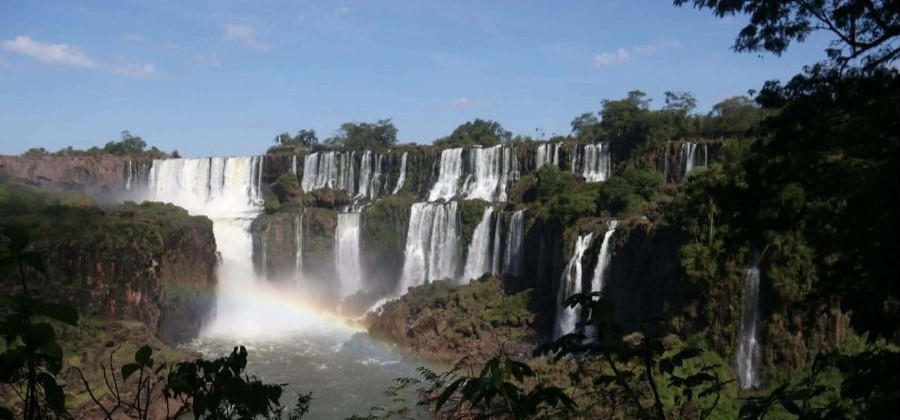
The Iguazu Falls are easily among the most awe-inspiring natural wonders in the world. Straddling the border between Argentina and Brazil, this massive waterfall system consists of more than 275 cascades of varying sizes and power, and can be fully experienced from both countries in just two days. For our first trip to this remote but fascinating part of the world (which sits at the junction of three countries, including Paraguay!), we knew we were coming for the nature rather than a plant-based culinary adventure. Still, visiting Iguazu Falls as a vegan is absolutely possible, and in this article, we’ll share everything you need to know to make your trip easy and enjoyable.
Introduction to the Iguazu Falls
- Best for: Massive waterfall systems, tropical wildlife (Coatis and Toucans), and powerboat adventures
- Base Cities: Puerto Iguazú (Argentina) and Foz do Iguaçu (Brazil)
- Getting around: Public buses connect the towns to the parks; bus or taxi for border crossings
- When to visit: Mar–May or Sept–Nov (milder weather); avoid Jan/Feb if you want to dodge the heat and crowds
- Fees & Cash: Both parks accept credit cards. Keep local cash (ARS/BRL) for small snacks or tips in the towns
- Connectivity: Good Wi-Fi at visitor centers
A breathtaking encounter with the power of nature, where the jungle mist and constant rainbows create one of earth’s most surreal landscapes.
This post contains affiliate links. If you make a purchase or booking through these links, we earn a small commission at no extra cost to you. This supports our work and allows us to keep offering free content here on the blog.
Why Visit the Iguazu Falls
The Iguazu Falls, also referred to as Iguassu,Iguazú, or Iguaçu, are far more than just a single waterfall. They are a massive system of up to 300 separate cascades (depending on the river’s water level), each varying in size, shape, and raw power. Straddling the border between Argentina and Brazil, the falls are tucked away in a remote corner of the continent; given the vast distances in both countries, most visitors choose to fly in.
After road-tripping through Argentina, Chile, Bolivia, and Peru, we had been flirting with the idea of visiting Iguazu for a while, but we weren’t entirely convinced yet. After all, we’d already seen our fair share of waterfalls, from the smaller gems like the Mok Fa Waterfall in Thailand or Kuang Si Falls in Laos to the impressive Tumpak Sewu in Indonesia. Could we really justify the extra time, money, and flights to see “just another” waterfall?
As you’ve probably guessed from the existence of this article: yes, we could, and we are so glad we did. And you should, too!

The Iguazu Falls aren’t just among the most breathtaking waterfalls in the world; they are some of the most stunning natural landscapes we’ve ever seen. It’s hard to wrap your head around just how immense they are or how much sheer natural power converges in this one place – all made surprisingly accessible thanks to the parks’ well-maintained infrastructure. As we strolled along the catwalks, the thought of how mind-blowing it must have been for the first explorers to stumble upon this wonder crossed our minds more than once.
Argentina or Brazil: What Side is Better?
The Iguazu Falls can be visited from both the Argentinian and Brazilian side, though each country has its own separate park entrance. While Argentina covers roughly 80% of the falls, Brazil offers a more panoramic “big picture” perspective from a distance. Both sides are relatively easy to visit, with convenient infrastructure including airports, buses, taxis, and gateway towns (Puerto Iguazú and Foz do Iguaçu, respectively) filled with accommodations and restaurants.
So, the eternal question that pops into most travelers’ heads: which side should I visit?
Like the majority of travel blogs, our answer is: both, if possible. While we consider ourselves budget travelers, we live by the mantra of never skimping on experiences – and visiting Iguazu Falls was definitely a once-in-a-lifetime moment! Especially if South America is a long journey for you and/or a destination you’re unlikely to return to soon, it really is worth spending the extra time and money for the full experience.

Each side offers a distinct perspective, and which one you prefer will ultimately come down to personal taste. For example, Daniel preferred the panoramic views of the Brazilian side, while Lynn couldn’t choose between the lower circuit in Argentina and the Devil’s Throat walkway in Brazil.
Here are the main characteristics and key differences between each side:
| Feature | Argentine Side | Brazilian Side |
|---|---|---|
| Perspective | “Within the falls” (Immersive) | “Facing the falls” (Panoramic) |
| Time Needed | Full Day (6–8 hours) | Half Day (2–4 hours) |
| Key Highlight | Garganta del Diablo (Top-down) | The “Big Picture” |
| Walking distance | Extensive (Upper/Lower circuits) | Short, single main trail |
| Vegan Food | Vegan empanadas in the park, vegan options in town | Buffets with large salad bars in the park, vegan options in town |
| Currency | Argentine Peso (ARS) | Brazilian Real (BRL) |
Iguazu Falls as a Vegan
Both Argentina and Brazil have cuisines that are heavily meat-dependent, so we were curious to discover how easy it would be to navigate the Iguazu Falls as a vegan. While it likely won’t be the most unforgettable culinary experience of your life, the vegan meals we found on both sides were actually pretty decent. We were also pleasantly surprised to find that the parks themselves offered some plant-based options, though, as with most tourist hotspots, the prices are definitely on the higher side. We personally preferred to pack some snacks (in our case: sandwiches with seitan and empanadas from La Vaca Empoderada) before heading to the falls.
Argentinian Side
Vegan Options in Puerto Iguazú
Be sure to check the opening hours for all the restaurants listed here. We’ve linked to their Google Maps pages, which generally show the most up-to-date info. During our visit, we noticed that many spots only opened in the late afternoon, likely to cater to travelers returning from a long day at the falls.
La Vaca Empoderada (100% vegan)
We are happy to report that Puerto Iguazú has a fully vegan restaurant! La Vaca Empoderada is run by dedicated vegans, and their passion for the cause is evident in everything they do. During our visit, we tried the burger, the seitan milanesa, and the soy empanadas. Everything was delicious and came in generous portions, and we loved the refreshing drinks. This is also the perfect spot to grab some takeaway empanadas for your day at the park! Besides the restaurant, they are also planning to open a small vegan supermarket. If you happen to visit once it’s open, please let us know in the comments!

Matchia Sushi
Inside De la Fonte Restaurante, you’ll find a sushi spot that serves clearly labeled vegan sushi and spring rolls. The restaurant is actually part of a larger food complex that includes an attached hamburger and pizza joint. While we didn’t sample everything, we’ve seen several reviews mentioning that they also serve vegan burgers, focaccia, and even gnocchi!
Night Wok Iguazú
While we didn’t have the chance to try this one ourselves, Night Wok Iguazú looks like a great, budget-friendly takeaway option for vegans in Puerto Iguazú. They serve fried noodles and vegetable fried rice.
Shawarma Alsultan
We also tried Shawarma Alsultan for a takeaway dinner after reading several comments about their vegan falafel options. In the end, however, we were slightly disappointed. While the falafel themselves tasted great, the vegan shawarma option was essentially just the vegetarian wrap without the sauce, which left it quite dry. On the plus side, the hummus plate was another solid vegan option that we enjoyed. We had also seen several reviews claiming their spinach empanadas were vegan, but once we arrived, the staff confirmed that the dough actually contains milk.

Peperina Alimentos Saludables (Supermarket)
Peperina Alimentos Saludables is a small health food store in Puerto Iguazú that stocks a wide variety of vegan products, including meat and dairy substitutes, protein bars, and plenty of snacks. They even carry vegan Alfajores (the iconic Argentinian cookie) which is an absolute must-try 😀 This is a fantastic place to stock up on vegan essentials or grab a few things for your visit to the park.
Vegan Options Inside the National Park (Argentina)
Inside Iguazu National Park, you’ll find several snack bars and restaurants scattered along the trails. At the snack bars, we were excited to find empanadas filled only with vegetables, and importantly, no cheese, which is often hard to come by!

There is also the option to eat at Restaurant La Selva or Fortin Cataratas, which both offer a buffet service. While we didn’t eat here ourselves, we suspect it might not offer the best value for money for vegans. However, if you do find yourself there, they have a few standard staples like pasta, rice, and various vegetable dishes. Next to Fortin Cataratas, there is an ice cream shop named Cremolatti (also in Puerto Iguazú Town). They have several sorbet variations, as well as some creamy versions made with almond milk! The banana split is an absolute must-try!
Brazilian Side
Vegan Options in Foz do Iguaçu
Cheiro Verde
While we didn’t make it into the town of Foz do Iguaçu ourselves, reading the reviews for Cheiro Verde almost makes us wish we had. This Chinese-influenced vegetarian buffet seems like the perfect lunch spot in the city for plant-based travelers. They offer a huge variety of dishes, including seitan, tofu, rice, noodles, and even vegan sushi, with all the vegan options clearly labeled to make your life easier.
Pop Art Cafe
Pop Art Cafe is a charming vegetarian café in Foz do Iguaçu that offers several great vegan options, including burgers, sandwiches, and even pastries. This is another excellent spot to grab a takeaway meal to bring with you to the waterfalls!
70’s Brunch Café
The cozy 70’s Brunch Café offers several clearly marked vegan options on its menu, including savory toasts and quiches. The café has a creative, trendy atmosphere and is one of the rare places in Foz do Iguaçu with continuous opening hours from morning until evening.
Nauá
For one of the healthiest food options in Foz do Iguaçu, head to Nauá. They specialize in build-your-own bowls, allowing you to choose from a wide variety of fresh, vegan-friendly ingredients, including tofu.
Vegan Options Inside the National Park (Brazil)
Inside the national park on the Brazilian side, Restaurante Porto Canoas offers an all-you-can-eat buffet with a view overlooking the upper falls. While we didn’t eat here ourselves, our research suggests it may offer a few more vegan-friendly staples than the buffet on the Argentinian side. According to various reviews, you can often find items like beans, rice, various salads, and fried bananas.

Highlights in the National Park
While the main goal of this article is to help you navigate the Iguazu Falls as a vegan, we cannot not share some impressions of the national park itself.
Argentinian Side
Let’s start on the Argentinian side. We don’t think it really matters which country you visit first, just do what fits best with your schedule. We once read a comment saying that the Brazilian side is like watching a movie, giving you a full-frame picture from a distance, while on the Argentinian side, you’re actually in the movie!

We found that to be a very cool and fitting analogy. The numerous walking paths on the Argentinian side really let you get up close to the falls, seeing them from countless different angles for a truly immersive experience. There are the Lower (1.4 km to 2.5 km) and Upper (1.7 km to 2.4 km) circuits, each offering unique perspectives. Then, of course, there’s the famous “Devil’s Throat” (Garganta del Diablo), a spectacular U-shaped abyss that lets you experience the full force of this massive body of water. The waterfall here is 82m high and carries approximately half of the river’s total flow! Expect to have your mind blown by this natural spectacle, and to get wet 😉
As one of the most iconic spots in the National Park, the Devil’s Throat gets understandably crowded. We arrived around 9:00 AM (with the park opening at 8:00 AM), and the viewing platform was already quite busy. If possible, arrive right at opening and head there first thing to enjoy the views with fewer people!
Bonus: Hummingbird Garden in Puerto Iguazú
If you have a bit of time to spare in Puerto Iguazú (even less than an hour is enough) we can wholeheartedly recommend Jardín de los Picaflores, a lovely family-run garden that attracts countless hummingbirds and other bird species thanks to the feeders scattered throughout the property.

While admittedly a little pricey for such a small place (around 15,000 ARS at the time of writing/ roughly 15€ / 17$ depending on the exchange rate), it offers the rare opportunity to observe hummingbirds up close, something we had never experienced before! Beyond that, the garden immerses you in an incredibly peaceful atmosphere filled with constant chirping, fluttering, and buzzing.
Brazilian Side
The Brazilian side of the Iguazu Falls is smaller and more compact than its Argentinian counterpart. It features one main walking path that takes around 90 minutes to two hours to complete, depending on your pace and how many photo stops you make. Here, you see the falls from a distance, which is just as impressive as being up close. It truly allows you to grasp the sheer scale of this natural wonder and just how immense these waterfalls actually are.

However, the most breath-taking moment for us came at the very end, when you experience the Devil’s Throat from an entirely different perspective. This time, you’re at the foot of the falls, standing right where the full power of the cascading water converges. It is, without a doubt, one of the most incredible things we have seen in our lives.

For full transparency: when we visited, the pathway leading to the viewpoint was extremely crowded, and the platform was packed with people competing for the best photo spot. This slightly dampened the experience, and was probably the only thing that kept us from completely breaking down over how amazing this piece of earth is! We even joked that the only reason to splurge on the famous Belmond Hotel das Cataratas inside the park would be to have this spot all to ourselves 😀

Still, the experience was utterly awe-inspiring. In moments like this, we like to take 20 seconds (or longer, if possible) to simply tune out our surroundings and fully absorb where we are. Even if there are impatient people waiting behind you, remember that this is your moment, too. Allow yourself to fully experience it, even if only for a brief heartbeat.
Accommodation Tips for the Iguazu Falls
Argentinian Side
We spent two nights in Puerto Iguazú and opted for an Airbnb. Our goal was to have a kitchen for self-catering, but as it turned out, we misread the listing: it only came with a microwave and a kettle, but no stove! While it was fine for heating up pre-prepared food, it wasn’t quite what we expected. Thankfully, the town still offered enough vegan choices to make eating out easy.
In retrospect, here are a few places we’d recommend checking out instead:
- Iguazú Apartments (30-40€/night): If we could go back, we’d book here. It’s a 2-bedroom apartment that actually includes a kitchen, and it even has a pool!
- Nuevo Residencial Uno (30-40€/night): A great hotel alternative that is very close to the bus station, which is where you catch the shuttles to the falls.
- Santa Marta (35-40€/night): Another highly rated and affordable hotel option.
- Hotel Guaminí Misión (80-150€/night): For a fancier stay outside of town, this is a great pick if you plan on taking taxis to the falls rather than the bus.
- Gran Meliá Iguazú (+600€/night): The ultimate splurge. It is the only hotel located inside the Argentine side of the national park. It offers spectacular views of the falls and although you can’t access the trails outside of the official times opening times of the park, the location still allows you to head out before the crowds arrive.

Brazilian Side
Even though we didn’t stay in Foz do Iguaçu ourselves, it is a very convenient base for visiting the falls from the Brazilian side. The town offers plenty of cosy accommodations for every style and budget. Here are a few highly rated recommendations:
- Hotel Rouver (around 40€/night): A friendly, well-located hotel with a swimming pool, situated very close to the town center.
- Condomínio Inn Studio (around 40€/night): These apartments feature private bathrooms and kitchenettes, perfect for preparing your own meals. While they are a bit further from the city center, they are conveniently close to local shops and markets.
- Apt NOVO Centro Garden (80-150€/night): A spacious, clean apartment that can house up to six people. It’s an ideal choice for families or groups and comes with excellent guest reviews.
- Belmond Hotel das Cataratas (+700€/night): The legendary pink hotel and the only accommodation located inside the Brazilian National Park. One major advantage here is that guests can visit the falls outside of official opening hours, allowing for a much more private experience. If we were ever going to go crazy with our money, this would definitely be the place 😉
Transport at Iguazu Falls
Transportation, and especially navigating the borders between the two sides of the Iguazu Falls, was one of the biggest question marks for us while planning this trip. So, here’s some hopefully useful information based on our experience. Also, when crossing borders, make sure to check the visa requirements and entry regulations for your nationality in advance!
Argentinian Side
In Puerto Iguazú, the transport system is straightforward and leans heavily on traditional buses and taxis.
- The Public Bus (Colectivo): The most common way to get to the park is the Río Uruguay bus. These depart every 20 minutes from the main bus terminal in the center of town. Look for the sign that says “Cataratas.” You can buy your ticket at the booth in the terminal or sometimes directly on the bus (cash only). It drops you off right at the park entrance.
- Taxis: You will see taxis everywhere. They are especially great if you are in a group of 3 or 4, as the price is often comparable to four bus tickets. While Uber technically exists in Argentina, it is very complicated in Puerto Iguazú. There is a lot of tension between ride-share drivers and the local taxi unions. We found it much more reliable and stress-free to stick to the official taxis or the bus.

Brazilian Side
Brazil is generally much more tech-friendly when it comes to transport, and getting to the falls is a breeze.
- Uber & 99: Unlike the Argentinian side, Uber (and the local app 99) works perfectly here. It is very affordable, fast, and easy to use.
- The 120 Bus: This is the “Airport/Falls” bus. It runs frequently from the main terminal (TTU) in the city center, passes the airport, and ends at the National Park entrance. It’s incredibly cheap and efficient.
- Taxis: Taxis are plentiful, but usually more expensive than an Uber.
Crossing the Border: Between Puerto Iguazú and Foz do Iguaçu
This is the part that confuses everyone! You have two main options to get from the Argentine town to the Brazilian park (or vice versa).
Option 1: The International Bus (Budget Friendly)
Several companies (such as Crucero del Norte or Río Uruguay) run international buses between the two towns. When you reach the crossing, the process involves two distinct steps:
- The Exit Stamp: The bus will stop at the first border (Argentine or Brazilian, depending on which direction you are traveling). You must get off to get your exit stamp. This part of the process is usually very quick and hassle-free, and the bus will typically wait for you to get back on before moving to the other side of the bridge.
- The Entry Stamp: When you reach the second border (the entry to the new country), you need to get off again to get your entry stamp. Since many locals (Argentines and Brazilians) don’t need to do this, the driver won’t automatically stop at the immigration building unless you explicitly ask them to when you board.
Once you let the driver know you need to hop out, they will drop you off at the control point and continue on their way. You will go inside to process your passport, and then you simply wait for the next bus from the same company to pick you up. These usually arrive every 30 to 60 minutes, just make sure to keep your original ticket, as it remains valid for the next driver.
If you don’t feel like waiting at the border for the next bus, you can also call an Uber (which works best on the Brazilian side) to pick you up right at the immigration office and take you the rest of the way to the falls or your hotel.
Option 2: Taxi or Private Transfer
If you don’t mind spending a bit of extra money, hiring a taxi to take you across the border is much faster. The driver will wait for you at both immigration booths while you get your stamps.
Packing List for the Iguazu Falls
| Category | Essential Items |
|---|---|
| Documents | Passport & Brazil eVisa (for US/CAN/AUS citizens since April 2026!) |
| Clothing | Quick-dry layers & a warm fleece for evenings |
| Footwear | Water-resistant walking shoes with high-grip soles |
| Electronics | Waterproof phone pouch & Universal adapter (Types N & I) |
| Health & Safety | High-DEET insect repellent & Yellow Fever certificate |
| Vegan Trail Kit | Reusable water bottle, nuts, & high-protein vegan bars |
| Miscellaneous | Microfiber travel towel & sunglasses |
Conclusion
As we mentioned earlier, we went back and forth for quite a while before finally booking our flights to visit the Iguazu Falls. The long distances, the extra flights required to visit “just” one destination, and the cost of two national park tickets made us hesitate more than usual. But in the end, we can say that it was completely worth it!
The Iguazu Falls truly are a once-in-a-lifetime destination. Between the roaring waterfalls, tropical wildlife, rainbows dancing through the mist, and the sheer scale of the landscape, this is one of those rare places that genuinely lives up to the hype.
And while visiting Iguazu Falls as a vegan naturally doesn’t compare to the abundance of options you’d find in larger cities, it is still more than manageable to stay well-fed throughout your trip. We were especially happy to discover La Vaca Empoderada in Puerto Iguazú, a dedicated vegan spot in such a remote, tourist-heavy area felt genuinely encouraging. So if you visit, make sure to support them and help the local vegan scene continue to grow.

This guide is completely free. If it helped you plan your trip and you’d like to say thank you, you can do so here 🙂

FAQ: Vegan Travel & Planning for the Iguazu Falls
Should I visit the Argentinian or Brazilian side of the Iguazu Falls?
Ideally, both. The Argentinian side offers a much more immersive experience with extensive walking circuits that bring you close to the waterfalls, while the Brazilian side provides sweeping panoramic views of the entire system. If you only have limited time, Argentina generally requires a full day, whereas Brazil can comfortably be visited in half a day.
How many days do I need for the Iguazu Falls?
We recommend spending at least two days at the Iguazu Falls: one full day for the Argentinian side and one half or full day for the Brazilian side. This gives you enough time to explore the trails without rushing and allows for potential weather changes.
Is Iguazu Falls vegan-friendly?
Surprisingly, yes! While both Argentina and Brazil are traditionally very meat-heavy countries, we still found several vegan-friendly restaurants and even some vegan options inside both national parks. Puerto Iguazú especially stood out thanks to dedicated vegan spots like La Vaca Empoderada.
Can I cross between Argentina and Brazil easily?
Yes, crossing the border is relatively straightforward. You can either use the international public buses running between Puerto Iguazú and Foz do Iguaçu or take a taxi/private transfer. Just make sure to check visa requirements for your nationality beforehand and always carry your passport.
What is the best time to visit the Iguazu Falls?
We recommend visiting during the shoulder seasons (March–May or September–November), when temperatures are milder and crowds are generally smaller. January and February can be extremely hot, humid, and busy.
Do you get wet at the Iguazu Falls?
Absolutely! Especially near viewpoints like the Devil’s Throat, the mist can be incredibly intense. Bring a rain jacket or poncho, and ideally a waterproof pouch for your phone or camera.
Are the Iguazu Falls worth visiting even if I’ve already seen other famous waterfalls?
In our opinion: 100% yes. Before visiting, we wondered whether the long journey and additional flights would really be worth it after already seeing waterfalls like Victoria Falls and Tumpak Sewu. But Iguazu completely exceeded our expectations and remains one of the most impressive natural landscapes we’ve ever experienced.
Are there animals at the Iguazu Falls?
Yes! The national parks are full of wildlife. During your visit, you will likely encounter coatis, butterflies, tropical birds, lizards, and possibly even toucans or monkeys. Just remember not to feed the coatis, as they are very used to tourists and can become aggressive around food.

About the Authors
Lynn & Daniel are the vegan couple behind VanderlustJourney, combining their passion for adventure and plant-based living. They share stories and visuals of natural places, hikes, vegan discoveries, and meaningful encounters from around the world – always striving to travel with kindness.
👉 Follow us on Instagram
✉️ Contact: vanderlustjourney@outlook.com
Further Reading
Blog Articles
South America Adventures:
- Day Hikes in Torres del Paine: Stunning Trails for Every Skill Level
- Best Hikes in Chile: From Patagonia to Atacama
- Vegan Atacama to Uyuni Tour: What It’s Really Like
Vegan Guides: